Guides
Home inspection business licences and permits, listed
A home inspection business needs a state inspector licence, entity registration, a local business licence, and insurance before the first job.
What to take away
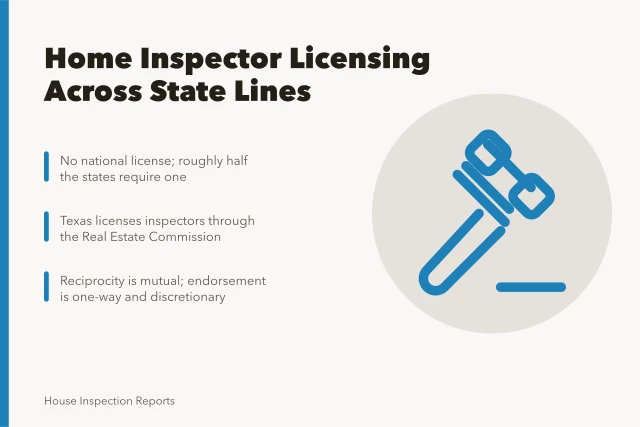
- The license that matters most to a home inspection business is the individual home inspector license. It comes from a state board such as the Texas Real Estate Commission, the New York State Department of State, or the Georgia board for home inspectors.
- Entity registration, a local business license, and errors and omissions insurance are separate permits, and each renews on its own cycle. The Texas, New York, and Florida inspector licenses run on two-year terms; city business licenses and insurance policies usually renew once a year.
- Radon, mold, and pest control work need separate credentials, such as an Illinois radon license from the Illinois Emergency Management Agency or a Texas mold assessor license.
- In a licensing state, wait until the license is issued before you advertise or accept a fee. Holding yourself out as a licensed inspector without one is what boards act on.
- Every renewal gets a date and a name, or it gets missed.
- Confirm each requirement with your state board and a licensed attorney, not with a competitor.
The licenses and permits, by name
These are the credentials most home inspection businesses carry. Which ones apply to you depends on your state and your services.
Home inspection credentials by name
- Texas Professional Inspector license (TREC)
- New York home inspector license
- Florida home inspector license (DBPR)
- Business entity registration
- IRS Employer Identification Number
- Local business license and sales tax permit
Texas Professional Inspector license (TREC). The Texas Real Estate Commission requires qualifying coursework and a passing score on the National Home Inspector Examination before you inspect for pay.
New York home inspector license. The Department of State, Division of Licensing Services, issues it. New York requires the license before you accept a fee for an inspection.
Florida home inspector license (DBPR). The Department of Business and Professional Regulation licenses home inspectors and requires a state exam. Georgia runs a separate residential inspection board. Some states have no license requirement at all, which does not remove your insurance or contract obligations.
Business entity registration. File Articles of Organization for an LLC, or Articles of Incorporation for a corporation, with your Secretary of State. Inspecting across a state line usually requires a Certificate of Authority as a foreign entity there.
IRS Employer Identification Number. Form SS-4 gets you an EIN at no cost. Banks, insurers, and payroll services ask for it before anything else.
Local business license and sales tax permit. Cities and counties issue these, and Los Angeles requires a Business Tax Registration Certificate. Texas issues a sales and use tax permit through the Comptroller.
Where inspection services are taxable, register before the first invoice. A city business license does not cover the next town over.
Errors and omissions (E&O) insurance. This covers missed defects and scope disputes. Some states require proof of E&O before they issue or renew the inspector license. General liability is a separate policy and does not cover professional mistakes.
Radon measurement credential. Many states require a separate radon license or a national certification. Illinois licenses radon professionals through the Illinois Emergency Management Agency, and AARST's NRPP certification covers the rest. The EPA's Home Buyer's and Seller's Guide to Radon explains why test conditions, timing, and documentation matter in a transaction.
Mold assessment license. Several states license mold assessment separately. Texas issues a mold assessor license through the Texas Department of Licensing and Regulation, and Florida issues one through DBPR. Where it is not licensed, certification through a trade body is what buyers and agents ask to see.
Wood-destroying insect license. FHA, VA, and many conventional loans require a termite report from a licensed pest control operator. In Texas, that is a structural pest control license from the Department of Agriculture, not a home inspector license.
EPA Lead-Safe Certified Firm. Work in pre-1978 housing falls under the EPA's Renovation, Repair and Painting rule. Firms certify through the EPA or an authorized state program, and lead inspections need a certified inspector or risk assessor.
Professional association membership. InterNACHI and ASHI are not licenses, but their standards of practice and report formats are what many agents and attorneys expect to see cited.
Vehicle and equipment registration. Company vehicles, ladders, and specialty tools carry their own registration or inspection requirements in some jurisdictions.
Where the paperwork usually breaks
The owner's inspector license rarely covers the whole operation. Entity registration, the local license, radon and mold credentials, pest control, and insurance each need their own renewal date. One approval does not cover another.
Renewal tracking by credential
- Inspector license
- Entity registration
- Local business license
- Radon and mold credentials
- Pest control
- Insurance
Write down what changes for licensed inspectors, report reviewers, schedulers, and customer-service staff. File the proof as you go, not when a buyer's attorney asks for it. A home inspection business plan should carry this list before the first job is booked.
Renewal dates are the moving part. Texas, New York, and Florida keep the inspector license on a two-year cycle. City and county business licenses usually renew each year, and errors and omissions policies run on the insurer's twelve-month term.
Fees come from each board's fee schedule, and the amount depends on the license type and the term. Where states publish figures, an inspector license commonly lands between $100 and $350 per term. Check the schedule at renewal instead of carrying a number forward.
For 2027, watch the details rather than the list. Boards amend rules and fee schedules, state legislatures take up licensing bills most sessions, and renewal cycles shift when a statute changes. Read your board's notices page and your renewal date each cycle, and treat last cycle's fee as a starting point.
This list covers United States credentials. Canada licenses home inspectors province by province: British Columbia licenses them through Consumer Protection BC, and other provinces set their own rules, so check the provincial regulator.
Safety and accessibility duties on the premises
OSHA's Safety Management guidance recommends finding and fixing hazards before an injury or inspection exposes them. For an inspection business that means ladder work, roof access, confined crawlspaces, and electrical panel checks.
The DOJ's ADA Guide for Small Businesses covers barrier removal and accessible routes for existing facilities.
The order of work
Order of licensing work
- Confirm which state board licenses inspectors
- List every license and certificate needed
- Match insurance to license conditions
- Give every renewal a date and name
- File proof as you go
- Confirm which state board licenses home inspectors where you operate: TREC in Texas, the Department of State in New York, DBPR in Florida. Check whether local rules add to it.
- List every license, registration, and certificate the business and its people must hold before the first inspection, including radon, mold, and pest control credentials.
- Match insurance to the license conditions and to what the home buyer will ask to see.
- Give every renewal and inspection a date and a name.
- File the proof as you go, not when asked.
Common questions
Do I need a license if my state does not require one?
No state license means no state credential to hold, but you still need entity registration, a local business license, and insurance. Some states without licensing still require disclosure to clients, so confirm with your state board.
Is E&O insurance the same as general liability?
No. General liability covers property damage and injuries on site. E&O covers missed defects and professional mistakes, which is the claim most inspection businesses actually face. Some states, Texas among them, require proof of E&O to renew the inspector license.
How do I hire inspectors who already hold the right credentials?
Check the state board's public license lookup before an interview, not after. TREC and the New York Department of State both publish one. A reliable hiring process should include that lookup as a first step, along with a copy of the license on file.
Where do I confirm the current requirements?
Your state board or licensing department for the inspector license, your city or county for the local business license, and a licensed attorney for contract and liability questions. Requirements change, so check the board's current page rather than a competitor's website.
This article covers general business information. It is not legal, tax, insurance, or engineering advice. Licensing, sanitation, and safety requirements vary by state and municipality, so confirm current requirements with your state board and a licensed attorney.