Guides
Insuring a home inspection business: policies, premiums and gaps
A home inspection business needs E&O, general liability and a commercial auto policy, and each one carries an exclusion owners discover only after a claim.
What to take away
- Errors and omissions (E&O) answers a missed defect. General liability answers a lamp you knock over, or a client who trips on your ladder. Commercial auto covers the truck between jobs.
- Typical annual premiums for a solo visual inspector run $1,000 to $3,000 for E&O, $400 to $1,500 for general liability, and $1,200 to $3,500 per vehicle for commercial auto.
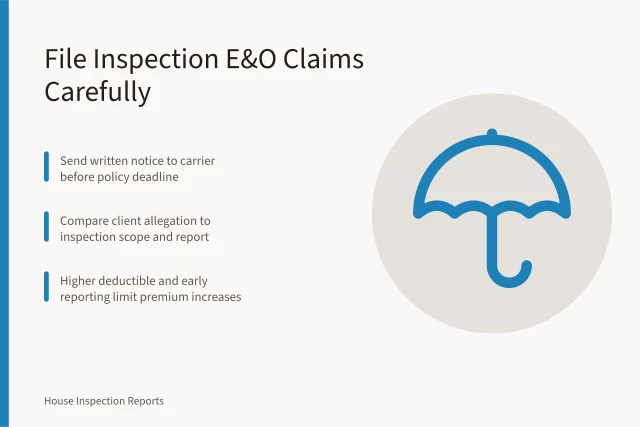
- Most inspector E&O is written on a claims-made basis. The policy in force on the day the claim is filed pays, not the one you held during the inspection.
- Radon testing, mold sampling and sewer scope sit outside a standard E&O form unless a scheduled-service endorsement names them.
- State boards set minimum coverage amounts. A carrier quote is not the same thing as the floor your license depends on.
The three core policies and what they cost
A home inspection business normally carries six coverages. Three do the heavy lifting.
E&O responds when a client says you missed something: a failed heat exchanger, a roof that leaked three weeks after closing. Limits commonly run from $250,000 to $1,000,000 per claim. Brokerages often want proof of $250,000 before adding you to a referral list.
General liability covers the physical world. It does not cover the quality of your report, and E&O does not cover the lamp you broke.
Insurance is one cost line among several, and the pricing and profit guide shows where the rest sit against an inspection price.
Six coverages and 2026 premiums
E&O
- Covers
- Missed defects
- Carriers
- Hiscox, CNA
- Solo premium
- $1,000-$3,000
- With add-ons
- $2,500-$6,000
General liability
- Covers
- Injury off-report
- Carriers
- Hartford, biBERK
- Solo premium
- $400-$1,500
- With add-ons
- Same
Commercial auto
- Covers
- Trucks and vans
- Carriers
- Progressive, biBERK
- Solo premium
- $1,200-$3,500
- With add-ons
- Per vehicle
| Policy | What it covers | Carriers and markets | Typical annual premium |
|---|---|---|---|
| Errors and omissions | Missed defects, report errors, professional services | Hiscox, Next Insurance, Philadelphia Insurance, CNA, Lloyd's syndicates | $1,000 to $3,000 solo visual; $2,500 to $6,000 with radon, mold or sewer scope |
| General liability | Bodily injury and property damage you cause | Hiscox, Next Insurance, The Hartford, biBERK | $400 to $1,500 at $1M/$2M limits |
| Commercial auto | Trucks and vans used for inspections | Next Insurance, biBERK, The Hartford, Progressive Commercial | $1,200 to $3,500 per vehicle |
| Commercial property or inland marine | Meters, infrared cameras, radon monitors | Hiscox, Next Insurance, biBERK | $250 to $1,000 for a $10,000 tool limit |
| Workers' compensation | Employee injury and illness | State funds, biBERK, The Hartford | State-set; often $1,000 to $4,000 for one full-time inspector |
| Umbrella | Limits above auto and general liability | Hiscox, The Hartford, Philadelphia Insurance | $500 to $2,000 for $1M |
Commercial auto matters because a personal policy normally excludes business use, and the drive to a job is the trip an adjuster will question.
What to re-check for 2027
Three things move at renewal. Your loyalty to a carrier is not one of them.
Rating basis. Carriers increasingly price E&O per inspection rather than flat, so a business running 1,200 inspections a year pays differently than one running 400. You report the count and settle up, usually quarterly. Tracking that count is an operations job, and the workflow guide shows how inspection volume gets recorded cleanly.
Carrier appetite for add-on services. Radon, mold and sewer scope are the lines carriers exit first when claims rise. Ask whether your endorsement survives renewal before you sell the service again.
State minimums. Boards raise coverage floors on their own timetable. A certificate that satisfied your board two years ago may not satisfy it now.
Premiums are deductible as ordinary business expenses under IRS Publication 535, which matters when a cheap policy and a broad one differ by more than the premium does.
Gaps that surface after a claim
- Claims-made lapse. Coverage stops responding when the policy lapses. Buy tail coverage before you close or sell the business.
- Prior acts. A new policy may exclude work done before its start date. Ask for prior-acts coverage in writing when you switch carriers.
- Ancillary services. Buy the scheduled endorsement by namea Radon Testing endorsement, a Mold Sampling or fungi endorsement, a Sewer Scope endorsement.
- Independent contractors. Confirm contract inspectors carry their own E&O, and confirm your form does not treat them as employees.
- Property type. Many forms cover one- to four-family homes only. Commercial buildings, pools and septic systems may need an endorsement.
- Pollution and fungus exclusions. A limited fungi or bacteria endorsement fills the mold gap in a general liability form.
Coverage gaps to check
- Buy tail coverage when closing or selling
- Get prior-acts coverage in writing
- Endorse radon, mold, sewer, termite
- Confirm contract inspectors carry own E&O
- Endorse commercial, septic, pools, code
- Add mold or pollution endorsement
The services and packages guide covers which add-ons earn back the extra premium.
Radon deserves its own note. Test conditions, documentation and timing decide whether a result holds up in a transaction, as the EPA explains in its guide for home buyers and sellers.
Example: the deferred meter repair
An owner skips a $900 repair on a moisture meter and an infrared camera during a slow spring. In August, a disputed finding after closing turns on a reading the failing meter produced.
Run the numbers. R is the repair cost, $900. C is the average cost of defending one disputed finding, a typical $12,000. P is the chance per year that a finding is disputed, a typical 0.02.
C times P comes to $240. Deferring wins only while R sits below that figure. At $900, it does not.
License minimums and where they bind
Licensing and scope of practice vary by state. The coverage floor usually belongs to the board, not your broker.
Texas is the clearest example. The Texas Real Estate Commission will not issue an inspector license without proof of professional liability coverage, and the commission expects the certificate kept on file.
Ontario licenses home inspectors under the Home Inspection Act, 2016, so an Ontario inspector working from United States assumptions may hold the wrong limit.
Safety rules sit outside the policy. Ladder use, crawlspace entry and panel work belong in a documented program, which supports your defense later.
The licensing and compliance guide lists what a board asks for before it issues or renews a license.
Common questions
Does general liability cover a missed defect?
No. General liability responds to bodily injury and property damage you cause. A missed defect is a professional services claim, which is what E&O is for.
Why did my premium rise after a claim the carrier did not pay?
Defense costs and the claim record both feed the next renewal. A claim counts against you whether the carrier settled it or fought it.
Do I need separate coverage for radon and mold testing?
Usually yes. Standard inspection E&O forms commonly exclude environmental sampling, so buy the named endorsement or a standalone policy before selling the service.