Guides
Home Inspection Certification in Canada: Ontario vs BC Requirements
Home inspection certification Canada has two models: Ontario uses association credentials, BC a mandatory licence. Here is how fees and rules compare.
What to take away
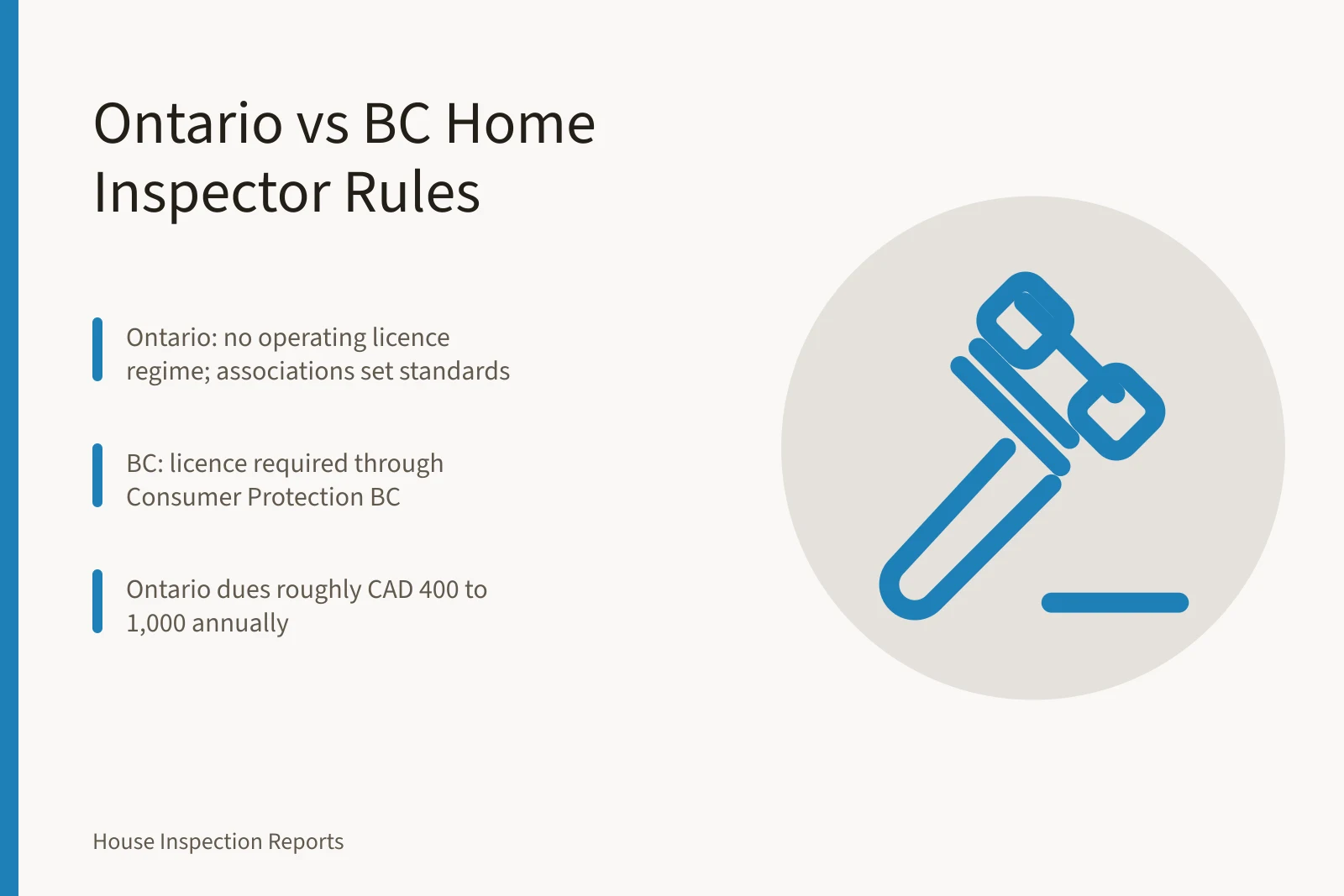
- Ontario has no operating licence regime for home inspectors. The Home Inspection Act, 2016 is on the books at ontario.ca but its licensing provisions have not been brought into force, so practice rests on association membership such as OAHI or CAPHI.
- British Columbia requires a licence through Consumer Protection BC, and you cannot legally trade without it.
- Fees differ in kind, not just size. BC charges a licensing fee plus exam and criminal record check costs; Ontario charges annual association dues, typically a few hundred to roughly a thousand dollars a year.
- Neither model certifies your competence across a border. A BC licence does nothing for you in Ontario, and an OAHI designation carries no legal weight in BC.
- Both routes leave the same gapsno national standard, no reciprocity, and no protection against a client who simply hires the cheapest inspector.
What is being compared
Two provinces, two philosophies. Ontario relies on trade associations to set entry standards and police members. British Columbia relies on a regulator with statutory power to refuse, suspend or cancel a licence.
A reader in either province is usually asking one question: what do I have to hold, and what does it cost me to hold it?
The answer changes depending on where you plan to work, and whether you intend to move.
The criteria that matter
Four things decide which model suits you: legal obligation, cost, portability and enforcement.
Ontario vs BC: Key Criteria
Ontario
- Legal requirement
- No operating licence
- Standard setter
- OAHI, CAPHI
- Annual cost
- CAD 400-1,000
- Enforcement
- Association discipline
- Portability
- None
British Columbia
- Legal requirement
- Licence required
- Standard setter
- Consumer Protection BC
- Annual cost
- CAD 500-1,200 year one
- Enforcement
- Statutory suspension
- Portability
- None
Ontario
- Legal requirement to hold a credential
- No operating licence regime
- Who sets the standard
- OAHI, CAPHI and other associations
- Typical annual cost
- Association dues, roughly CAD 400 to 1,000 (illustrative range)
- Enforcement
- Association discipline, membership suspension
- Portability
- None across provinces
British Columbia
- Legal requirement to hold a credential
- Licence required to inspect for a fee
- Who sets the standard
- Consumer Protection BC
- Typical annual cost
- Licence fee plus exam and record check, roughly CAD 500 to 1,200 in year one (illustrative range)
- Enforcement
- Statutory suspension or cancellation
- Portability
- None across provinces
Costs vary by association tier and by how many add-on designations you carry, so treat the ranges as planning figures rather than quotes.
Ontario: association certification in practice
The Ontario route is voluntary in law and near-mandatory in the market. Most agents and brokerages expect a designation, and many will not book an inspector who lacks one.
OAHI and CAPHI both run education requirements, a mentored inspection count and a written exam. Dues are annual and rise with the class of membership you hold.
Because the regulator is an association, the consequence of a bad report is a complaint and a discipline process rather than a government suspension. That matters if you are buying errors and omissions coverage, since insurers price on the standard of care you claim to meet.
British Columbia: licensing under Consumer Protection BC
BC took the other path. Inspectors must hold a licence, carry insurance and meet continuing education requirements, and the regulator publishes the conditions attached to a licence.
A licence can be refused or pulled. That is the practical difference from Ontario: the state, not a membership body, decides whether you may work.
Fees are set by the regulator and reviewed periodically, so check the current schedule before you budget. First-year costs also include the exam and a criminal record check.
Where each one wins
Ontario suits the inspector who wants a low barrier to entry and is willing to build a reputation through association work and referrals. The referral engine inside a home inspection owners is the real credential in that market.
BC suits the inspector who wants a clear legal line between qualified and unqualified competitors. A licence is easier to explain to a consumer than a designation from a body they have never heard of.
BC also wins on enforcement. If a competitor is working without a licence, you have somewhere to report it.
Ontario wins on flexibility. You can start inspecting while you complete a designation, which shortens the gap between training and revenue.
What none of them solve
Neither model creates a national standard. Move from Vancouver to Toronto and you start over with a different body, different fees and a different vocabulary for the same work.
Both models also leave pricing to the market. Certification tells a client you met a bar; it does not tell them what an inspection is worth, and inspectors in both provinces still compete on price in slow months.
Add-on services such as radon and mold testing sit outside both regimes, which is why pricing inspections in high-cost and low-cost U.S. metros offers a useful contrast for anyone setting rates north of the border.
Certification answers who may work. It does not answer what the work is worth, and no province has fixed that.
Example: the same inspector, two provinces
A Vancouver inspector holds a BC licence, pays the annual fee and files continuing education hours. She moves to Ottawa.
Moving from BC to Ontario
- Vancouver inspector holds BC licence
- Moves to Ottawa
- BC licence becomes irrelevant
- Joins Ontario association
- Completes education and mentored inspections
- Insurance follows, credential does not
Her BC licence is irrelevant. She joins an association, pays dues, and completes the Ontario education and mentored inspection requirements before most agents will book her.
Her insurance follows her. Her credential does not. That is the whole comparison in one move.