Guides
Home inspection service quality reviewed: what holds up and what does not
A review of home inspection service quality finds that written standards, review sampling and complaint records hold up, while vague promises do not.
What to take away
- Service quality holds up when the standard is written, dated, and owned by a named person, and it fails when the promise lives only on the website.
- Home inspection service quality is easiest to judge against the published standards from InterNACHI and ASHI, which name what is covered and what is excluded.
- Sampling twenty to thirty closed files a month catches more than an annual audit, because patterns show up in weeks, not quarters.
- A complaint is closed when the cause is recorded and later work is checked, not when the reply is sent.
- Near misses belong in a log that nobody is punished for, or the next one becomes a claim.
- Pay review uses published wage data as an input, never as a target, because your metro and your mix set the number.
This article covers operations only. Licensing, contracts, liability exposure and tax treatment vary by state and by agreement. Confirm those with your state licensing board, a licensed attorney, or a CPA.
The claim that does not survive contact
Most inspection companies describe quality with words no one can check. "Thorough." "Detailed." "Client first." A buyer reads that and learns nothing they can hold you to.
Read the published standards instead. InterNACHI's Standards of Practice lists what a general inspection covers and what it leaves out, including underground piping, septic systems and pools unless those are added to the scope. ASHI's Standard of Practice and Code of Ethics do the same job for members, and both documents are free to read.
Home inspection service quality holds up when the file matches one of those documents. It fails when the file matches only the website.
The practices that survive a review are dull and specific. A written scope with a revision date. A named reviewer. A file that shows what was inspected and what was excluded. A complaint trail that ends in a changed procedure.
The practices that fail are the ones that depend on a person remembering. Verbal handoffs between the inspector and the office. Standards kept in one inspector's head. Quality reviewed once a year, in a meeting, from memory.
State rules set a floor underneath all of it. New York licenses home inspectors through the Department of State's Division of Licensing Services, and Texas licenses them through the Texas Real Estate Commission. In states with no license, the trade association standard is the only written bar.
Where the money actually leaks
Quality failures cost more than the reinspection. They cost the second visit, the report revision, the agent who stops calling, and the E&O claim that starts with a missed shutoff valve.
Four monthly quality costs
- Reinspection hours
- Report revision hours
- Credits or refunds issued
- Labor cost of complaint handling
A return visit commonly eats one to two hours of drive and on-site time, plus the office work to amend the report. E&O deductibles for a single-inspector firm typically run $1,000 to $5,000 per claim, and annual premiums often land between $1,000 and $3,000.
Track four costs per month: reinspection hours, report revision hours, credits or refunds issued, and the labor cost of complaint handling. Add them. That total is your quality spend, and most owners have never seen it on one line.
Compare it against revenue per completed inspection. Single-family inspection fees commonly run $300 to $500, set by market and house size. If quality spend climbs while volume holds flat, the standard is drifting, not the market.
What a real standard contains
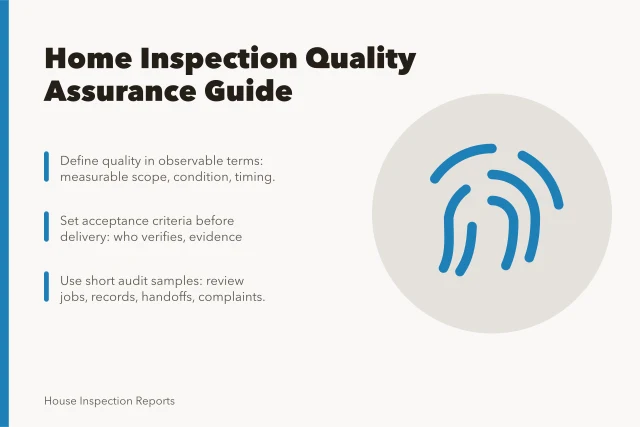
A usable standard names the observable result, not the effort. For a roof, that means which areas are walked, which are viewed from the ground, and what the report says when access is refused. InterNACHI and ASHI both let an inspector report from the ground instead of walking the roof, provided the report states the method used.
What a usable standard names
- Roofareas walked, viewed from ground
- Roofreport note when access refused
- Panelamperage recorded
- Panelbreaker labeling noted
- Panelnote when dead front stays on
- Exclusion list written beside inclusion list
- Every version dated, old ones pulled
For a panel, the standard covers the amperage recorded, the breaker labeling, and the note when the dead front stays on.
Write the exclusion list next to the inclusion list. Buyers argue about what they assumed, and a written exclusion ends the argument faster than a phone call.
Date every version and pull the old one out of circulation. An inspector working from a superseded checklist is a defect waiting for a deposition.
Two tools appear in well-documented files: a moisture meter, such as the Tramex Moisture Encounter, and a thermal camera, such as the FLIR One. A finding logged without a reading or an image is a memory, and memories lose in a claim.
If you are drafting the operating document from scratch, the inspection business plan structure covers how scope, staffing and pricing fit together before you write the quality section.
Sampling that finds problems early
Pull a fixed number of closed files each month. Twenty to thirty is enough for a shop running under 200 inspections; scale it to roughly one in ten above that.
Five file review checks
- Scope matches the agreement
- Photos support the findings
- Exclusions are stated
- Report delivered inside promised window
- Follow-up question got documented answer
Report software makes the pull mechanical. Spectora and HomeGauge both store the report, the photos and a delivery timestamp, so a reviewer can settle the five checks in minutes. Cloud plans for those two typically run about $100 to $200 per user per month. Office platforms such as ISN add scheduling, agreements and delivery tracking on top.
Review the exceptions, not the average. A file that scored four out of five tells you where the process bent, and bent processes repeat.
Rotate who reviews. The owner reviewing the owner's own inspections finds nothing.
Complaints as operating data
Five complaint log fields
- What the client expected
- What the evidence shows
- Who responded
- How it was resolved
- What changed afterward
The last field is the one that matters and the one most often left blank. If nothing changed, the same complaint is scheduled to arrive again.
Set a response window and hold it. A complaint answered in one business day costs less than the same complaint answered in a week, because the client has already called the agent by then.
Do not offer incentives for reviews or ask only the clients you expect to be happy. The FTC guidance on soliciting and paying for online reviews sets out what makes a review practice deceptive, and selective asking is on that list.
The FTC's rule on fake reviews took effect in 2024, which puts paid reviews, review gating and invented reviews at risk of civil penalties. Google Business Profile and Yelp both prohibit incentivized reviews in their content policies. A steady drip from every client beats a burst from the happy ones.
Pay, capacity and the quality ceiling
Quality drops before revenue does. The first sign is usually a rushed report, then a missed follow-up, then a complaint.
Wage pressure shows up here first. Inspectors who feel underpaid stop walking the roof, and roof access is where the written standard loosens in practice.
Use the BLS Occupational Employment and Wage Statistics tables to see what inspectors earn in your state and metro, then compare against your own offer including drive time and report-writing hours.
Home inspectors sit in the Construction and Building Inspectors group, SOC 47-4011, where median annual pay lands in the high five figures and the top decile clears $100,000 in several metros. Many firms pay inspectors a share of the fee rather than an hourly wage, so a thin schedule cuts pay before it cuts quality.
If your pay sits below the local figure and your quality spend is climbing, the two numbers are related. Fix the schedule before you fix the standard.
Records that hold up later
Every quality decision needs a paper trail. The IRS recordkeeping guidance allows any system that clearly shows income and expenses, provided the underlying documents survive.
For inspection work, keep these records for the period your state board and E&O carrier require:
- the agreement
- the report
- the photos
- the delivery timestamp
- the complaint correspondence
Ask both. A carrier such as InspectorPro or Allen Insurance commonly asks for records going back five years or more, and that request is longer than the state's.
Radon and other ancillary services carry their own documentation duties. The EPA guide for buyers and sellers on radon explains why test conditions and timing matter in a transaction, and those details belong in the file, not in a summary email.
A short-term test needs closed-house conditions, so the start time, the device placement and who closed the windows all go in the record. Radon measurement credentials come from AARST-NRPP, and that number is worth putting in the file.
The monthly review meeting
Ninety minutes, once a month, four items on the agenda.
- Sampled files and their exceptions, with the reviewer's notes.
- Open complaints, their age, and what changed after each one.
- Near misses logged since the last meeting, with no names attached.
- One corrective action from last month, checked against this month's work.
End with one change, one owner, one date. A meeting that produces four changes produces none.
Common questions
How many files should we sample?
Enough to see a pattern, small enough to finish in a morning. One in ten closed files works for most shops, with a floor of twenty a month. Sample the same week each month so the comparison is honest.
Which written standard holds up best?
InterNACHI's Standards of Practice or ASHI's Standard of Practice, whichever your state board or insurer recognizes. Cite the version and the date in the report, and attach the exclusion list to the inspection agreement.
What if an inspector refuses to follow the written standard?
That is a supervision question, not a quality question. Document the gap, retrain once, and treat a second refusal as an employment decision with your attorney's input. A standard nobody enforces is worse than no standard, because it proves you knew.
Do we need a dedicated quality manager?
Not until you are past roughly 400 inspections a year. Below that, the owner or the lead inspector can run the sample and the monthly meeting, provided the person reviewing is not reviewing only their own work.
How do we know the standard is working?
Reinspection hours fall, complaint age falls, and the same exception stops appearing in sampled files. If all three hold for two quarters, the process is doing its job. If quality spend rises while those three improve, you are measuring more carefully, not failing.