Guides
Home Inspection Franchise vs Independent: Costs and Control Compared
Home inspection franchise vs independent comes down to fees, royalties and control. Compare franchise costs, startup ranges and the limits both share.
What to take away
- A franchise trades an upfront fee and ongoing royalties for branding, training and lead systems. An independent inspector keeps all revenue but buys every system themselves.
- Under the FTC Franchise Rule, a franchisor must hand you a Franchise Disclosure Document before you pay anything. That document is where the real numbers live.
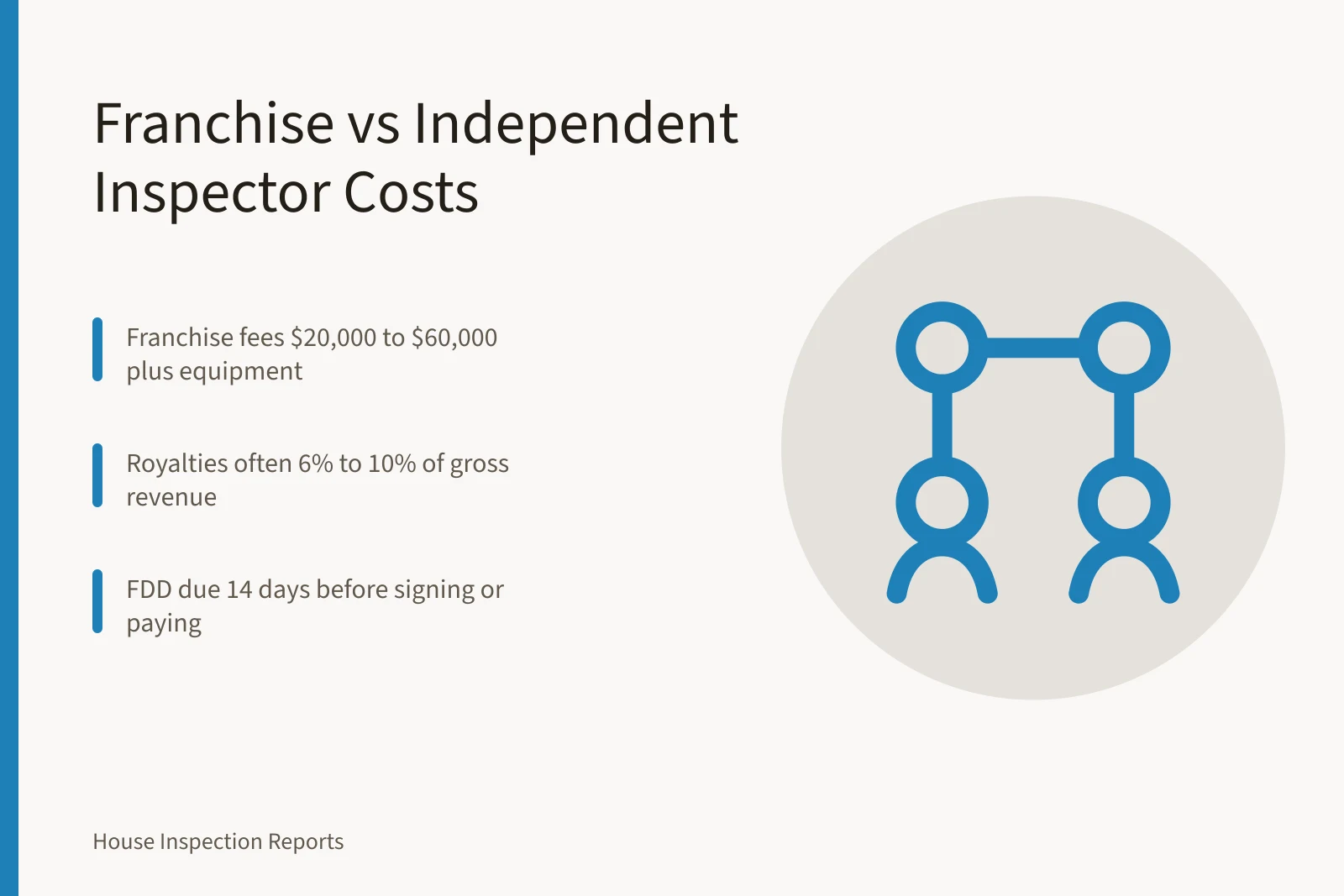
- Franchise initial fees commonly run $20,000 to $60,000, with royalties often 6% to 10% of gross revenue. These are illustrative ranges, not quotes.
- Independent startup in Texas or Florida often lands between $8,000 and $25,000, mostly software, insurance, tools and licensing.
- Neither path fixes demand. Both depend on agent relationships and referral flow.
What is being compared
Two ways to enter the inspection trade. A franchise sells you a proven operating model under a national name. An independent business sells you nothing except the freedom to build your own.
The choice is not about quality of inspection. It is about who pays for brand recognition, training and lead generation, and who controls pricing, territory and add-on services.
The criteria that matter
Franchise
- Initial cash outlay
- $20,000 to $60,000 typical, plus equipment
- Ongoing fees
- Royalty 6% to 10% of gross, plus ad fund
- Training
- Structured, often multi-week
- Lead flow
- National call center and web leads
- Pricing control
- Set or capped by franchisor
- Territory
- Defined radius, protected
- Exit
- Transfer subject to franchisor approval
Independent
- Initial cash outlay
- $8,000 to $25,000 typical
- Ongoing fees
- None
- Training
- Self-sourced, varies
- Lead flow
- Owner-generated
- Pricing control
- Fully owner-set
- Territory
- Unlimited, self-defended
- Exit
- Sell to anyone
The SBA's guide to choosing a business structure frames this as a control question as much as a money question.
The disclosure document is the real price list
Franchisors must give you a Franchise Disclosure Document at least 14 calendar days before you sign or pay. The FTC's Franchise Rule compliance guide explains what each of the 23 items covers, including fees, territory and franchisee turnover.
Read Item 5 for initial fees, Item 6 for ongoing royalties, Item 20 for how many franchisees left the system. A franchisor that resists questions about Item 20 is answering one.
Option by option
Franchise. You pay for a name, a script and a pipeline. In Texas, where the state does not license home inspectors, that training and template package carries real weight for a newcomer. In Florida, where the state does license, you still need the state credential first, so part of the franchise value overlaps with what you must already do.
Royalty Math on One Job
- $450Houston 2,500 sq ft inspection fee
- 8%Typical royalty rate
- $36Royalty sent to franchisor per job
- 400Inspections per year
Independent. You keep the margin and set your own prices by metro. A Houston inspector charging $450 for a 2,500 square foot house keeps the whole fee. The same job under a 8% royalty sends roughly $36 to the franchisor. Multiply that across 400 inspections a year.
Where each one wins
A franchise is the right answer when you have capital, no inspection background, and you want leads and training on day one rather than in year two. It also suits a buyer who wants a documented playbook for hiring, since a training checklist for home inspection staff is easier to run when someone hands you the sequence.
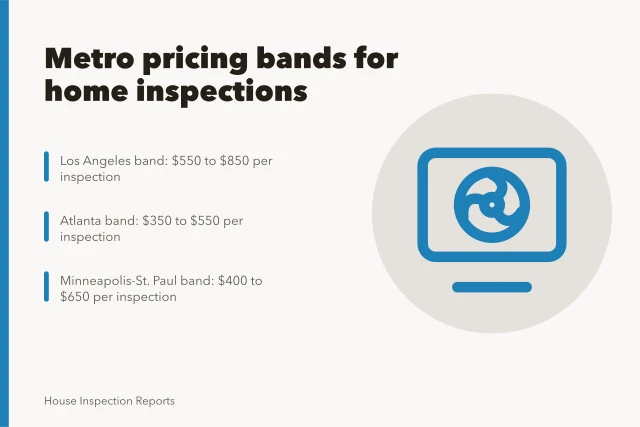
Independent is the right answer when you already have agent relationships, a license, and a market you know. You can price by neighborhood data, as covered in pricing inspections in high-cost and low-cost U.S. metros, and you can add radon or mold work without asking permission.
Royalty math is the whole argument. At $300,000 gross, a 8% royalty is $24,000 a year, every year, for as long as you hold the agreement.
Costs that surprise both sides
Errors and omissions insurance is the line item that catches newcomers. Coverage for professional negligence is not optional in practice, because agents and lenders ask for proof. The Wikipedia overview of errors and omissions insurance describes what the policy actually covers.
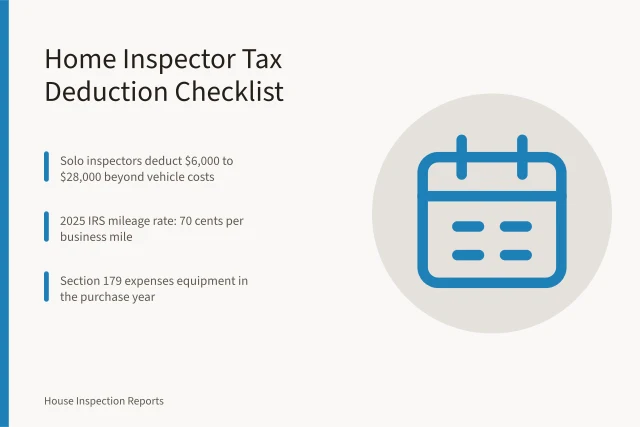
Both models also carry the same tax treatment. Software, tools, insurance and mileage are deductible, and how IRS rules shape taxes for a home inspection business walks through which categories apply.
What none of them solve
Neither option manufactures demand. A franchise call center sends leads only when the national brand has local pull, and independents must build referral flow one agent at a time, a task covered in working with real estate agents in Houston and Phoenix.
Both also share one hard limit: liability follows the inspector, not the sign on the truck. A franchise agreement shifts fees and branding, not the standard of care you owe a buyer.
Common questions
How long is a typical franchise agreement?
Terms usually run 5 to 10 years with renewal options. Read the renewal clause before signing, because renewal fees and remodel obligations often appear there.
Can I buy a franchise if I am not yet licensed?
In licensed states like Florida, no. You need the state credential before you can inspect, so sequence licensing first and franchise onboarding second.
Do franchisors set my prices?
Many publish a recommended fee schedule and some enforce minimums. That is a control trade, not a cost trade, and it belongs in your comparison.
What is the biggest hidden cost?
Marketing. Franchise ad funds and independent ad spend both run monthly, and neither guarantees a booked inspection.