Guides
How to Value a Home Inspection Business: Rules of Thumb for Sellers
Home inspection business valuation: compare SBA 7(a) cash flow, revenue multiples, and asset sales for Arizona and Colorado owners before listing.
What to take away
- For home inspection business valuation, sellers should compare three methods: SBA 7(a) cash-flow, revenue multiple, and asset-based.
- Typical revenue multiples for solo inspection firms run from 0.4x to 0.8x annual gross revenue, a range that is illustrative, not a quote.
- SBA 7(a) cash-flow works when a buyer needs lender financing; revenue multiples work for owner-operator handoffs; asset-based works when equipment is the main sellable item.
- All three methods miss inspection quality risk, referral concentration, and non-compete enforceability until due diligence.
What is being compared
Home inspection businesses sell on three common valuation bases. SBA 7(a) cash-flow is one method that lenders use to size a loan.
A revenue multiple is another, popular with small owner-operator transfers in Arizona and Colorado. An asset-based method is a third, which values vehicles, cameras, moisture meters, and a client list separately. A seller should run all three, then match the result to the likely buyer.
The criteria that matter
Use these four tests when comparing methods: data availability, buyer type, lender requirements, and downside risk. The table below shows each method against those tests.
Valuation Methods vs Criteria
SBA 7(a) cash-flow
- Data needed
- Tax returns, add-backs
- Buyer type
- Franchise or regional
- Lender view
- Preferred for loans
- Downside risk
- Add-backs challenged
Revenue multiple
- Data needed
- Gross receipts by year
- Buyer type
- Solo inspector
- Lender view
- Acceptable for small loans
- Downside risk
- Margins ignored
Asset-based
- Data needed
- Equipment list, receivables
- Buyer type
- Competitor buying assets
- Lender view
- Weak collateral
- Downside risk
- Undervalues recurring revenue
Data needed
- SBA 7(a) cash-flow
- Tax returns, add-backs
- Revenue multiple
- Gross receipts by year
- Asset-based
- Equipment list, aged receivables
Buyer type
- SBA 7(a) cash-flow
- Franchise or regional buyer
- Revenue multiple
- Solo inspector buyer
- Asset-based
- Competitor buying assets
Lender view
- SBA 7(a) cash-flow
- Preferred for loans
- Revenue multiple
- Acceptable for small loans
- Asset-based
- Weak collateral
Downside risk
- SBA 7(a) cash-flow
- Add-backs can be challenged
- Revenue multiple
- Margins ignored
- Asset-based
- Undervalues recurring revenue
Option by option
SBA 7(a) cash-flow. This method starts with seller's discretionary earnings or EBITDA, then adds back owner salary, depreciation, and personal auto costs. SBA's business value and startup cost guidance shows why lenders want documented cash flow, not owner hopes.
A standard SBA 7(a) loan is capped at $5 million, and the agency publishes no revenue multiple, so lenders work from cash flow or a business appraisal. To build a defensible number, a seller can take four steps:
SBA 7(a) Cash-Flow Steps
- Assemble three years of tax returns and P&L statements
- Add back owner compensation and one-time costs
- Normalize inspection volume for seasonal swings
- Apply lender-accepted multiple or capitalization rate
- Start with three years of tax returns and profit and loss statements.
- Add back owner compensation and one-time costs using IRS Publication 535 as the reference for deductible and non-deductible items.
- Normalize revenue and costs for market-rate rent, a manager's salary, and personal vehicle use.
- Put each add-back in a lender-ready schedule that ties to a source document.
Revenue multiple multiplies trailing annual gross revenue by a factor. Treat the 0.4x to 0.8x range as typical for owner-dependent firms, not a quoted benchmark. The exact factor comes from referral concentration, owner hours, and how much work survives the seller's exit.
A Phoenix solo inspector with $180,000 gross revenue and low overhead might see an illustrative range of 0.5 to 0.75, yielding $90,000 to $135,000, not a hard offer.
A Denver firm doing 400 inspections a year may trade at 0.55 to 0.75 because Colorado buyers pay for winterized market knowledge.
Asset-based. This method sums the fair market value of truck, thermal camera, radon monitor, and office equipment, then adds a small amount for a non-compete or client list.
A ten-year-old inspection truck and camera gear may clear $15,000 to $25,000 in an asset sale. The recurring inspection book may add only $5,000 to $10,000, and this is the floor method for aging owner exits.
Where each one wins
SBA 7(a) cash-flow fits a regional buyer or a private equity-backed platform that needs lender financing. The revenue multiple fits a solo operator selling to another licensed inspector who takes over the route and referral network.
The asset-based method fits equipment late in its useful life and thin recurring revenue, where a competitor buys assets to expand territory without inheriting the seller's liability. If two methods produce very different numbers, the seller prices to the buyer who can close and checks that buyer's financing before negotiating.
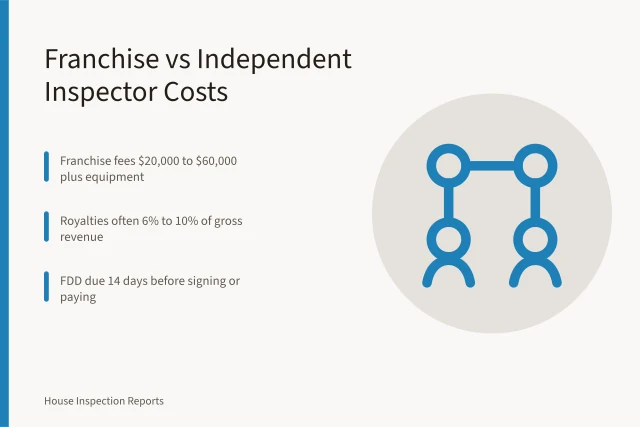
For more on how a buyer structures the next operating entity, see Home Inspection Franchise vs Independent.
Illustrative example: Arizona and Colorado
A Phoenix owner with $210,000 gross revenue, $75,000 owner salary, and $40,000 other add-backs might show $115,000 SDE. An SBA buyer using a 2.5x SDE multiple would offer around $287,500, while a revenue-multiple buyer at 0.6x would offer $126,000.
A Colorado Springs inspector with 320 annual jobs, heavy snow-season volume, and a salaried lead inspector may present EBITDA of $88,000 after normalizing payroll. An SBA lender may accept 2.75x EBITDA, or $242,000. A local competitor buying the same book may offer 0.7x gross revenue of $160,000, or $112,000, because the competitor pays for jobs, not for owner earnings.
These examples are illustrative ranges for planning, not appraisals. No number here is a benchmark for every US market.
What none of them solve
All three methods rely on historical numbers and can miss forward risk. That shared limit means a buyer still needs field due diligence. None captures inspection quality, complaint history, or how tightly the seller holds referral relationships with real estate agents.
A buyer who ignores these factors may pay for revenue that leaves after the non-compete expires. Sellers can reduce surprises by preparing a due diligence checklist:
Due Diligence Checklist
- Last three years of tax returns and P&L statements
- Inspection software export of jobs by zip code and gross revenue
- Non-compete and referral agreement copies with term dates
- Equipment list with purchase date and current condition
Every method also ignores state license portability. For example, an Arizona buyer cannot assume a Colorado inspector's license transfers across state lines; the seller's book in Colorado has no value to a buyer who cannot practice there. For more on this issue, see State licensing for home inspectors.
Common questions
How do sellers find a home inspection business for sale multiple? Ask business brokers in Arizona or Colorado for closed transactions on solo inspection firms. Use the 0.4x to 0.8x gross revenue band as a planning range, then adjust for referral concentration and owner hours. What should a seller fix before listing? Clean up owner add-backs and separate personal auto costs. Review How IRS rules shape taxes for deductible expenses that affect SDE. How does a non-compete affect value? A sale multiple falls if the non-compete is weak or expires in under two years. Review Home Inspection Contract Clauses to see which liability terms transfer. What if a buyer wants to buy only assets? Use the asset-based method and price equipment separately. Do not assign a large value to goodwill unless inspection volume is recurring.