Guides
When a home inspection business is ready to expand
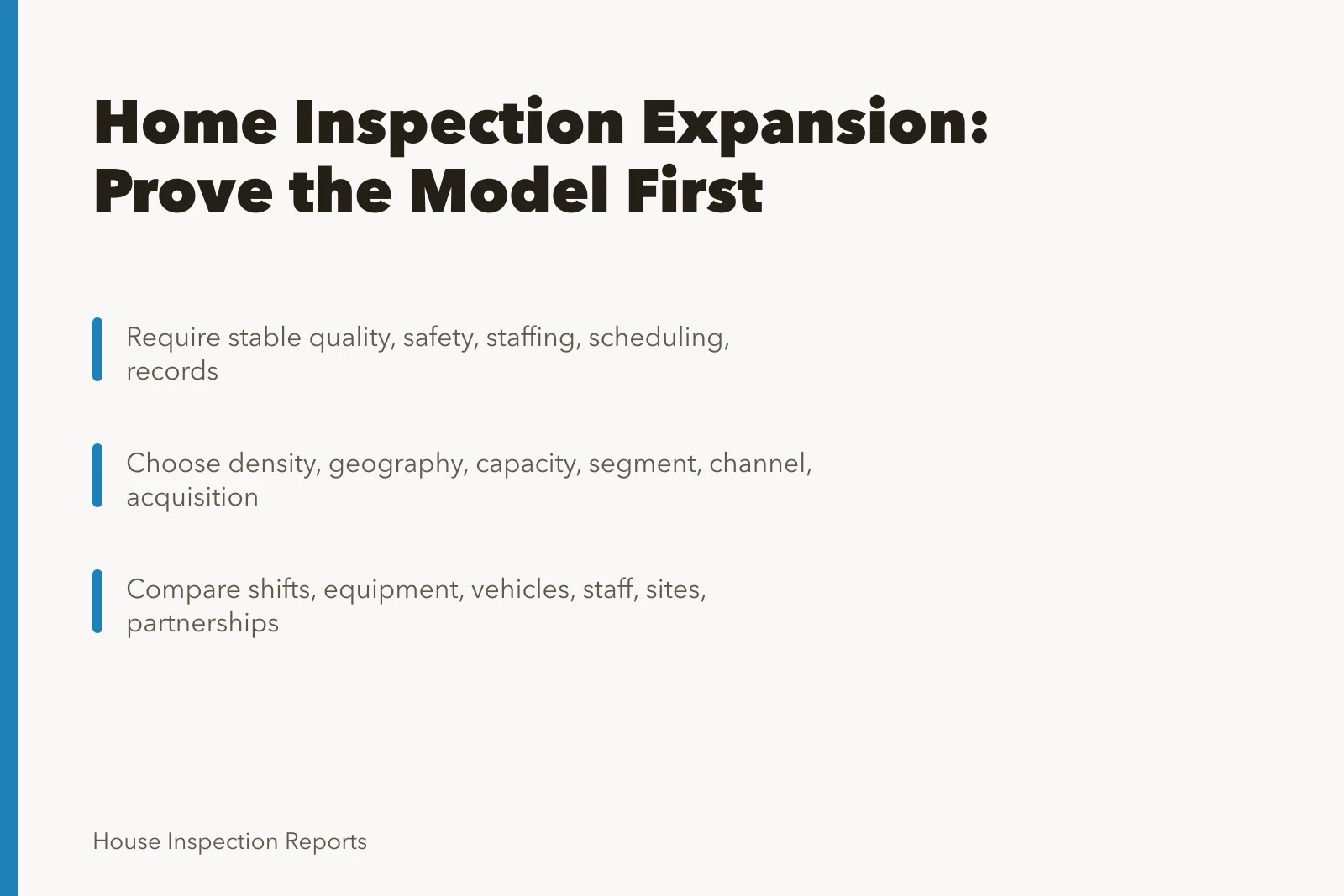
Expansion works when the current inspection model is stable and the new market's demand, licensing and cash needs are proven before you commit.
What to take away
- Do not open a second market until the first one runs a full quarter without you approving routine exceptions.
- Name the constraint before naming the formata second inspector, a second truck, a satellite office and a franchise solve four different problems.
- Price the new market from its own fee schedule, not from your home metro's, because travel time and report volume per day differ.
- Carry the report standard, the pre-inspection agreement and the complaint path into every new market unchanged.
- Set a stop rule in dollars and dates before the first dollar is spent, and write down what would make you cancel.
Why the current model has to be boring first
Expansion multiplies whatever the existing operation already does. If report turnaround slips when two inspections land on the same afternoon, a second market turns that slip into a pattern.
Three monthly numbers to track
- Inspections completed per scheduled day
- Report delivery time from site arrival
- Re-inspection or callback rate
The test is a full quarter in which the owner approves no routine exceptions. Schedules hold, reports go out inside the promised window, and complaints close without the owner rewriting the process.
Track three numbers monthly before you consider growth: inspections completed per scheduled day, report delivery time from site arrival, and re-inspection or callback rate. If any of them moves the wrong way for two months, fix it first.
What the expansion is actually for
Four goals get called expansion, and each one needs a different build.
Four expansion goals and builds
Density
- What it means
- More inspections in territory
- What it needs
- Marketing and agent relationships
- Relative cost
- Low overhead
Geography
- What it means
- Second metro or state
- What it needs
- Licensing, local presence, market study
- Relative cost
- High overhead
Capacity
- What it means
- More inspections per week
- What it needs
- Hiring and training
- Relative cost
- Cheapest when demand exists
Succession
- What it means
- Inspector who can own clients
- What it needs
- Compensation path
- Relative cost
- Not a marketing budget
Density means more inspections inside the territory you already drive. It usually needs marketing and agent relationships, not new overhead.
Geography means a second metro or a second state. It needs licensing, a local presence and a market study.
Capacity means more inspections per week than your current inspectors can produce. It needs hiring and training, and it is the cheapest of the four when demand already exists.
Succession means bringing in an inspector who can eventually own client relationships. It needs a compensation path, not a marketing budget.
Write the goal in one sentence with a number and a date. "Add a second inspector in Phoenix by March to cut our turnaround from nine days to five" is a goal. "Grow the business" is not.
The role map for a second market
A single-inspector operation has one person doing everything. Expansion splits that work, and the split has to be named before hiring starts.
Roles to name before hiring
- Licensed inspectoron-site inspection, report findings
- Report reviewersecond read before delivery
- Ancillary specialistradon, mold, sewer, thermal
- Schedulerbooking, confirmations, access instructions
- Administratorinvoicing, records, insurance certificates
- Ownerpricing, licensing, contracts, complaints
| Role | Owns | Typical trigger to add it |
|---|---|---|
| Licensed inspector | On-site inspection, report findings | Demand exceeds one inspector's weekly capacity |
| Report reviewer | Second read before delivery, standard compliance | More than one inspector writing reports |
| Ancillary specialist | Radon, mold, sewer scope, thermal work | Client demand or agent requests justify certification |
| Scheduler | Booking, confirmations, access instructions | Owner is answering the phone during inspections |
| Administrator | Invoicing, records, insurance certificates | More than one inspector or market |
| Owner | Pricing, licensing, contracts, complaint resolution | Never fully delegated |
In most states the inspector role is licensed or certified at the state level, and the requirements differ. Confirm the current rules with your state licensing board before you recruit in a new state, and treat any secondhand summary as a starting question rather than an answer.
Studying a new market before you commit
A market study for an inspection company answers five questions, and none of them is "do houses exist here."
Five market study questions
- How many active agents close deals in target ZIPs?
- What do competing inspectors charge and include?
- How long is the drive between farthest jobs?
- What does the state require for licensing and reports?
- What is the median housing stock age and implications?
- How many active real estate agents close transactions in the target ZIP codes, and how many already have a preferred inspector?
- What do competing inspectors charge for a standard single-family inspection, and what does that fee include?
- How long is the drive between the farthest jobs a normal day would combine?
- What does the state require for licensing, continuing education and report standards?
- What is the median age of the housing stock, and what does that imply for the ancillary services buyers will ask about?
Question five matters more than it looks. Older housing stock in cold climates pushes demand toward heating, plumbing and roofing checks, and toward snow load questions that belong to a licensed professional engineer, not to you. In warm coastal markets, wind mitigation and flood documentation drive the same kind of add-on work.
Radon is its own decision. The EPA's Home Buyer's and Seller's Guide to Radon explains why test conditions, documentation and timing matter in a transaction. If you plan to offer testing, check your state's certification requirements and refer mitigation questions to a certified mitigator.
The cash model, in variables you fill in
New-market cash need is not the same as new-market revenue. Build it in named variables so you can rerun it when a quote changes.
Cash model variables
- NInspections per month at steady state
- FAverage fee in the new market
- VVariable cost per inspection
- XMonthly fixed cost
Line / Variable
- Inspections per month at steady state
- N · Use your pilot result, not your hope
- Average fee in the new market
- F · From local competitor pricing, not your home metro
- Variable cost per inspection
- V · Travel, report software, ancillary consumables
- Monthly fixed cost
- X · Local presence, insurance, software, phone, storage
- Ramp months before N is reached
- M · Count them; they are the expensive part
- One-time setup
- S · Licensing, equipment, training, launch marketing
Monthly contribution is N times (F minus V), minus X. The cash you need before the market pays for itself is roughly S plus M months of the shortfall between that contribution and X.
Two lines get forgotten. Opening months rarely hit N, and receivables from agents and brokers arrive on their own schedule, so working capital has to cover the gap between doing the work and collecting for it.
For wage inputs, the Bureau of Labor Statistics Occupational Employment and Wage Statistics tables publish estimates by occupation, state and metro area. Use them as one input when you check whether your offer will attract an experienced inspector.
What stays identical across markets
Some things should not be localized. The report standard, the pre-inspection agreement, the complaint path and the insurance limits travel with you.
If your home market uses the InterNACHI or ASHI standard of practice, decide deliberately whether the new state's licensing rules require something different, and confirm that with the state board rather than assuming.
Scope language is where new markets go wrong. A buyer in a market you have never worked will ask for something your agreement does not cover, and an inspector who improvises creates a scope dispute. Give every inspector one written answer for the three most common out-of-scope requests in that market.
Complaints follow the same path in every market: acknowledge in writing, name the reviewer, review the report against the standard, and respond inside a fixed window. The owner keeps final say on any complaint that could become a claim.
The pilot and the stop rule
Run one limited pilot before committing to a lease, a hire or a franchise fee. A pilot is a defined number of inspections in the new market over a defined period, staffed by an inspector you already trust.
Pilot stop rule
Did the pilot hit expected inspections per day, fee, and turnaround?
Expand
Revise model and run second pilot, or stop
Write three things before the pilot starts: the result you expect, the earliest sign it is failing, and the dollar amount at which you stop. A useful stop rule names a date and a figure, not a feeling.
At the end of the pilot, compare actual inspections per day, actual fee collected and actual report turnaround against the model. Then choose one of three outcomes: expand, revise the model and run a second pilot, or stop.
Where to get the rest of the numbers
Your own books are the first source: twelve months of fee schedule, labor cost and overhead per inspection. A CPA can turn that into the cash model above and tell you what your current structure supports.
The Small Business Administration's business guide covers many topics in one place. It is useful when you assemble a checklist for a new state. The guide covers:
- planning
- launch
- permits
- insurance
- finance
- hiring
Licensing, contracts and liability exposure are state-specific. Confirm them with your state licensing board or a licensed attorney. Tax treatment of a new entity, a vehicle or a second location belongs with a CPA. Structural and safety questions about a specific property belong with the applicable building code authority or a licensed professional engineer.
If the expansion is a first formal plan rather than a second market, the home inspection business plan covers the sections a lender or a partner will expect to see.
Common questions
How many inspections per week should one inspector carry before I hire?
There is no universal number, because drive time and report complexity set the ceiling. Measure your own inspector's completed inspections per scheduled day for a full quarter, then hire when demand consistently exceeds that figure for two months. Hiring before the pattern is stable hides the real constraint.
Do I need a separate license to inspect in another state?
Usually yes, and the requirements differ by state, sometimes by which services you offer. Check the licensing board in the state where the property sits before you accept a job there. Some states also require separate certification for radon, mold or septic work.
Can I run a second market without a local presence?
You can, but travel time and access problems eat the margin. A local inspector, a local scheduler or a partner arrangement usually costs less than the drive. Model both versions in the cash table before deciding.
What is the most common reason expansion fails?
Counting new capacity as fully used from day one. Ramp months, collection timing and the cost of the owner's attention are the three lines that get left out of the model, and together they turn a profitable plan into a cash problem.