Guides
Home inspectors: what the experienced already know
A working shortlist of 25 home inspection companies, with what each one's public model shows an owner about pricing, coverage, report style and hiring.
What to take away
- The 25 companies below are named so home inspectors can read their public pages, not so you can copy them. Read each one for how it prices, what it covers and how it recruits.
- A franchise page tells you the royalty and territory rules. An independent page tells you the service mix. Both are free research.
- Compare any model against your own numbersinspection fee, drive time, report turnaround, and what your E&O policy actually covers.
- Nothing here is a ranking, and no company on the list has been tested or endorsed by this publication.
- Licensing, radon and mold rules vary by state. Confirm with your state board and the EPA before you add a service.
This article is general business information. It is not engineering, environmental, building-code, licensing, tax or legal advice. Confirm scope and duties with your state licensing board, a licensed attorney, or a licensed professional engineer.
What experienced home inspectors know, and how to read this shortlist
Two associations publish the standards most inspectors work to. The American Society of Home Inspectors and the International Association of Certified Home Inspectors both post their Standards of Practice online. Each lists what a visual, non-invasive inspection covers, and what it leaves out.
Read either standard before you read any company page. A home inspection is not a code review and not an engineering report. Veterans name their exclusions in writing: the roof seen from the ground, the hatch screwed shut, the panel they could not open.
The habits that separate a five-year inspector from a first-month one are mostly about water. Check the roof flashing, the deck ledger, the grading at the foundation, and the supply lines under every sink. Photograph the water heater data plate for its manufacture date. Test the garage door auto-reverse and every GFCI outlet.
Tools support that work. They do not replace eyes and a ladder. A moisture meter and a thermal camera tell you where to look next. Roofs get walked when the pitch allows it, and photographed from the eave when it does not.
Pricing is the other thing new owners guess at. In most markets a single-family inspection runs about $300 to $500, and it climbs with square footage, foundation type, crawlspace and travel time. Radon testing typically adds $150 to $250, mold sampling $400 to $600, and a sewer scope $150 to $300.
Insurance is the cost newcomers miss. Errors and omissions and general liability premiums move by state and by claims history, so no list can quote yours. Ask your carrier whether the policy is claims-made or occurrence, and get the retroactive date in writing.
Each entry below names a real company and what its public material is useful for. Nothing more. No entry has been tested, ranked or endorsed here.
Read a franchise disclosure document if the company franchises. Read the sample report if it publishes one. Read the careers page to see what it pays and how it trains. Then write down your own version of the same three things: fee schedule, report standard, hiring plan.
The 25, with what each is worth reading for
- WIN Home Inspectionfranchise model, so its disclosure document shows royalty structure and territory rules.
- Pillar To PostHome Inspectors: long-running franchise with published package tiers, useful for comparing add-on pricing.
- HouseMaster Home Inspectionsfranchise with a stated service guarantee, worth reading for how it words a warranty.
- AmeriSpec Inspection Servicesfranchise under a larger services group, useful for seeing how a non-inspection parent company handles the brand.
- National Property Inspectionsfranchise with a stated recruiting pipeline, useful for training structure.
- HomeTeamInspection Service: publishes sample reports, useful for report format comparison.
- A-Pro Home Inspectionfranchise with a stated multi-point checklist, useful for scope language.
- BrickKicker Inspection Servicesregional franchise, useful for how a smaller network words its territory map.
- Home Inspection Carolinaindependent, useful for a single-market service mix.
- US Inspectnational company with commercial and multi-family lines, useful for scope beyond single-family.
- BPG Inspectionspublishes package tiers, useful for add-on pricing comparison.
- Ally Property Inspectionsindependent, useful for a lean one-office model.
- Residential Inspector of Americaregional operator, useful for multi-office coverage language.
- Castle Property Inspectionsindependent, useful for a small-market fee schedule.
- AmeriHome Inspection Servicesindependent, useful for a referral-driven model.
- HomePro Systemsregional operator, useful for how it bundles ancillary services.
- Super InspectorTexas-based, useful for a high-volume metro model.
- InsideOut Property Inspectionsindependent, useful for a single-metro service list.
- Certified Property Inspectionindependent, useful for a narrow scope statement.
- HomeCheckInspection Services: publishes package tiers, useful for tier naming.
- Inspection Certification Associatestraining provider, useful for what new inspectors are taught before hire.
- Inspectifysoftware-enabled booking model, useful for how scheduling is priced and sold.
- Axium Inspectionsregional operator, useful for a multi-service inspection and testing mix.
- Elite Group Property Inspectionsindependent, useful for a small-team structure.
- Magnified Home Inspectionsindependent, useful for a local SEO and referral footprint.
Two names on this list sell training rather than inspections. That is deliberate: what a training provider teaches is what your next hire will already believe.
What the list is not
It is not a ranking, and it is not a compliance shortcut. Companies change ownership, coverage and pricing without notice, so verify anything you plan to act on.
The list is also not a market study. For that, read the market and expansion guide instead.
Turning the reading into your own numbers
Pick three companies from the list. For each, note the fee, the report turnaround and the add-on list. Then price the same job in your own market.
Cost Per Inspection, Step By Step
- Pick three companies from the list
- Note fee, turnaround, add-on list
- Price the same job in your market
- Add inspector pay and drive time
- Add report time and insurance share
- Divide by inspections per month
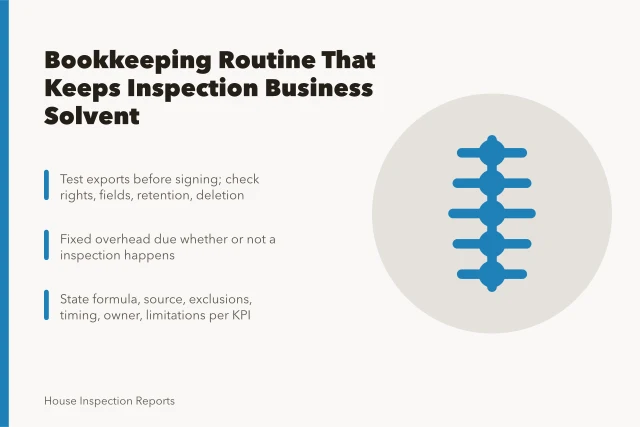
Your cost per inspection is not the fee. It is inspector pay plus drive time plus report time plus your share of E&O and general liability premiums, divided by inspections per month. Put your own figures in those slots. This publication does not publish wages or premiums because both move by state and by carrier.
The Bureau of Labor Statistics wage tables give you a checkable local figure for inspector pay by metro. The SBA business guide covers the planning, permits, insurance and hiring steps around it. Neither one sets your price.
Where the reading stops and the rules start
If you add radon testing, the EPA guide for buyers and sellers explains why test conditions and documentation matter in a transaction. It does not tell you what your state requires.
The EPA action level for radon is 4 picocuries per liter. The agency recommends testing every home below the third floor.
Mold, radon and licensing rules vary by jurisdiction. Your state licensing board sets the scope you may legally inspect. A certified industrial hygienist or the EPA sets the health guidance. Neither is a business decision you can copy from a competitor's website.
Common questions
Are these the best home inspection companies in 2027?
No. They are 25 real companies with public material worth reading, chosen for what each one shows about pricing, coverage or hiring. No ranking, test or endorsement is implied.
Can I copy one of these models directly?
No. A franchise model carries royalty and territory obligations, and an independent model reflects one local market. Use them to frame questions, then answer those questions with your own fee schedule and cost records.
What do new inspectors get wrong most often?
They list a defect without saying what it affects, and they skip the line about what they could not inspect. Write the cause, the consequence and the fix in plain language. That line limits what the report claims.
What should I charge for an inspection?
Start with local comparables: single-family inspections in most markets run about $300 to $500. Radon, mold and sewer scopes price separately, and your drive time decides the margin.
How often should I re-check this list?
Once a year, or whenever you change your service mix. Ownership, coverage and pricing change without notice, so verify anything before you act on it.