Guides
How Long Does a Home Inspection Report Take to Deliver?
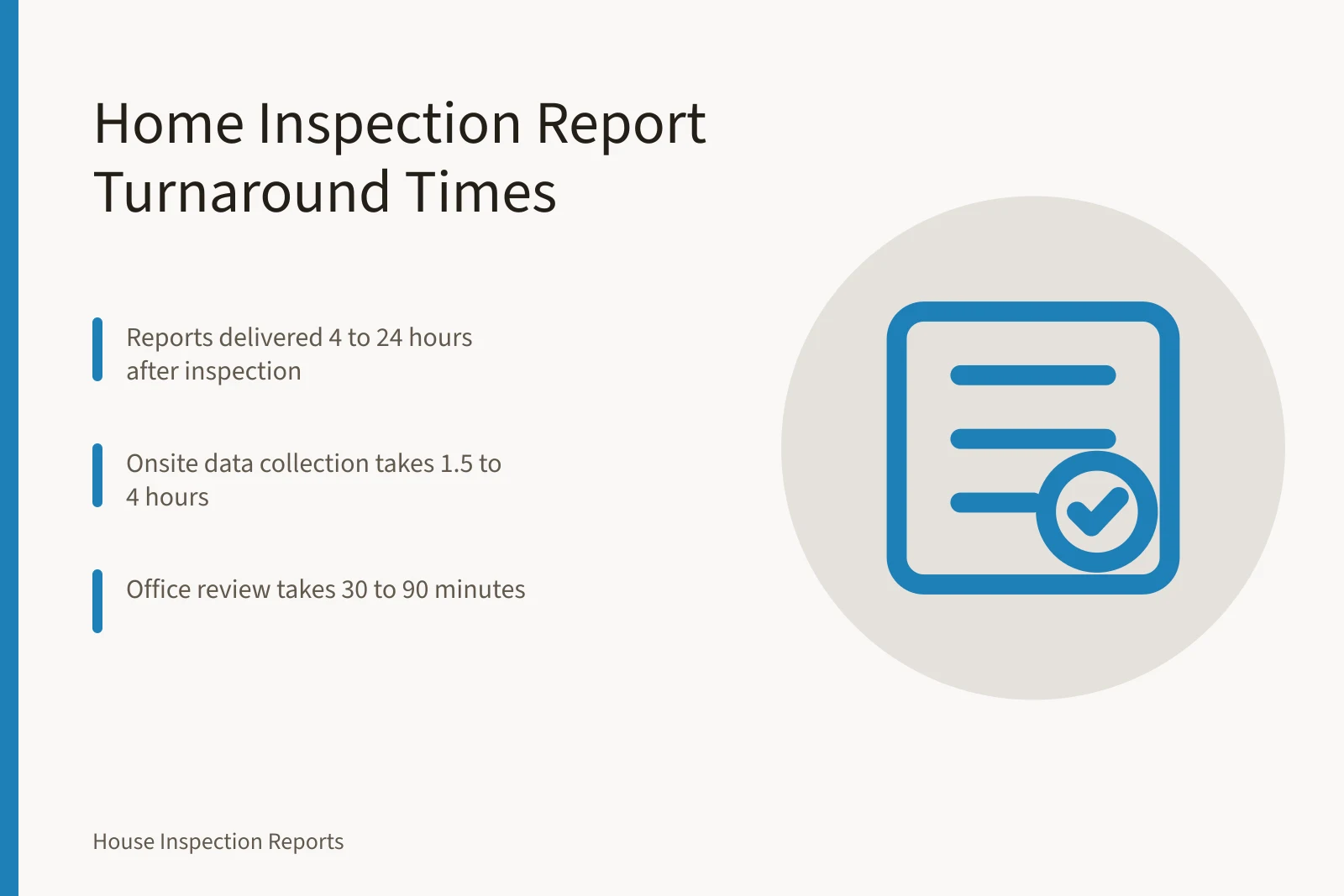
Home inspection report turnaround time runs 4 to 24 hours in most US markets. Same-day delivery and 24-hour review windows depend on phase completions and access.
What to take away
- Most US home inspectors deliver reports same day, often within 4 to 8 hours of leaving the job site.
- A 24-hour delivery window is a common upper bound for firms that run a second review.
- Turnaround is built from three phasesonsite data collection, draft production, and office review and delivery.
- A blocked phase, such as a missing crawlspace moisture reading, can add a full day or more.
- Seasonal weather and access problems cause the longest realistic delays.
The short version
A home inspection report usually goes out 4 to 24 hours after the onsite inspection ends. Solo inspectors with mobile report software often deliver same day. Larger firms with peer review often set a 24-hour deadline.
ASHI and InterNACHI standards set no universal delivery clock. The inspector's contract and state licensing rules set the binding deadline. Home inspection owners service quality checks often review delivery times. That review keeps same-day promises realistic.
Phase by phase
Onsite data collection takes 1.5 to 4 hours for a typical 2,000 square foot house. A larger or older home can stretch this to 5 hours if the inspector opens multiple electrical panels, walks a full attic, and tests every window.
Report phases and durations
- Onsite data collection1.5-4 hours
- Draft production1-3 hours
- Office review30-90 minutes
- Delivery15-30 minutes
Draft production takes 1 to 3 hours after the walkthrough. The report is usually assembled in the home office or the car using a template. Custom narratives add the most time.
Office review takes 30 to 90 minutes. This phase covers photo matching, defect classification and summary page edits. Delivery takes 15 to 30 minutes once the file is uploaded and the client email is sent. The time spent on report production is an ordinary business expense, as the IRS explains in Publication 535.
| Phase | Typical duration | What can extend it |
|---|---|---|
| Onsite data collection | 1.5-4 hours | Crawlspace, attic, detached structures, locked panels |
| Draft production | 1-3 hours | Custom narratives, video clips, thermal image annotation |
| Office review | 30-90 minutes | Peer review, defect classification, photo matching |
| Delivery | 15-30 minutes | Client portal upload, large file size, agent copy requests |
What has to finish before what
The onsite phase must close before drafting starts, since a reporter cannot write a finding for a photo that was never taken. A missing electrical panel photo blocks the electrical section. A pending radon result can delay the entire deliverable if radon is part of the contract.
Report phase dependencies
- Onsite data collection
- Draft production
- Office review
- Delivery
The summary page waits on the review phase, and this dependency is a hard blocker: no draft, no review, no delivery. The InterNACHI and ASHI report standards define what must be pictured and described, which shapes which missing items block a report.
Where schedules slip
Tablet or camera failure mid-inspection is a common slip and forces the inspector to retake attic or roof photos later, adding 30 to 60 minutes.
Common schedule delays
- Tablet or camera failure30-60 min
- Extra photo requests45-90 min
- Photo annotation overload10-15 min/room
A buyer or agent requesting extra photos after the inspector leaves causes a second delay. That call can take 45 to 90 minutes and often requires a return trip.
Photo annotation overload is a third delay. In a large home, adding arrows and labels to each defect can add 10 to 15 minutes per room.
The worst case is a missing moisture meter reading in a crawlspace that is no longer accessible because the seller locked the hatch. That single failure forces a reinspection and can push delivery from same day to 48 or 72 hours.
Same-day delivery is not a promise to write the whole report from the driveway. It means the inspector collected complete data before leaving, then assembled and reviewed it without a second visit.
A training checklist for home inspection staff removes many of these slips by setting a go/no-go list before the inspector leaves the driveway.
Seasonal and weather constraints
In northern states, winter inspections run shorter because snow hides roof surfaces and the inspector must wait for a clear day or use drone photos. In Florida's rainy season, a wet roof at the start can dry enough by the end. Report delivery can sit an extra hour while the inspector verifies moisture readings.
Extreme heat in Phoenix slows attic work; an inspector may start earlier and deliver later. Crawlspace access in Seattle after heavy rain can be mud-blocked, forcing a rescheduled visit and a report delay of one to two days.
Humidity and condensation make thermal imaging less reliable, so the review phase takes longer when the inspector has to discard unreliable frames. The seasonal marketing moves for inspection businesses in Florida and Texas track these same weather windows, because report speed changes with the season.