Guides
4 seasonal marketing moves for inspection businesses in Florida and Texas
Florida inspection demand bends around hurricane season and Texas around closing peaks, so four dated marketing moves beat one calendar for both.
What to take away
- Florida demand bends around the Atlantic hurricane season, June 1 to November 30. Texas demand bends around closings, February through August.
- Four dated movespre-season outreach in May, closing-peak campaigns in Texas, storm response after a named event, and off-season retention.
- NOAA's Atlantic outlook lands in late May and resets every coastal conversation. Texas runs on contract dates, not weather.
- Storm work pays only where agent relationships and a response plan already exist. Build both before the first named storm.
- Count inspections booked per dollar and per hour. Clicks do not schedule jobs.
Two states, two demand clocks
Florida and Texas both sell inspections, but the demand curves do not match. Florida's calendar bends around the Atlantic hurricane season, June 1 through November 30. Texas bends around closings, which cluster from February into August.
In Florida, the pre-season window matters most. NOAA maintains a prediction for below-normal Atlantic hurricane season activity in its outlook, and agents, lenders and homeowners still read it closely. Coverage lands in late May and resets the conversation in every coastal market.
In Texas, transaction volume drives everything. Spring buying runs February through May, then summer closings push into July and August. Inspectors in Dallas, Houston, Austin and San Antonio see the same shape: short notice, tight scheduling, repeat agent requests.
That difference should split your budget. Florida money goes into readiness and storm response. Texas money goes into capacity and agent coverage during closing peaks.
NOAA climate information explains why the two states diverge. Rainfall, heat and storm exposure change what buyers ask inspectors to check, which should change your messaging, not just your schedule.
If you want the wider strategic picture before you build the calendar, start with these lessons about home inspection marketing.
Why one calendar fails both states
Florida inspectors sell wind mitigation, roof condition and flood exposure. Texas inspectors sell foundation, HVAC and roof age during a fast closing. Different services, different outreach.
Agents in Florida want to know you can turn a report around after a storm. Agents in Texas want to know you can handle three inspections in a day during May.
Write two versions of every campaign: one for coastal Florida, one for Texas metros. Same offer, different proof.
Move one: pre-season outreach before the Atlantic outlook lands
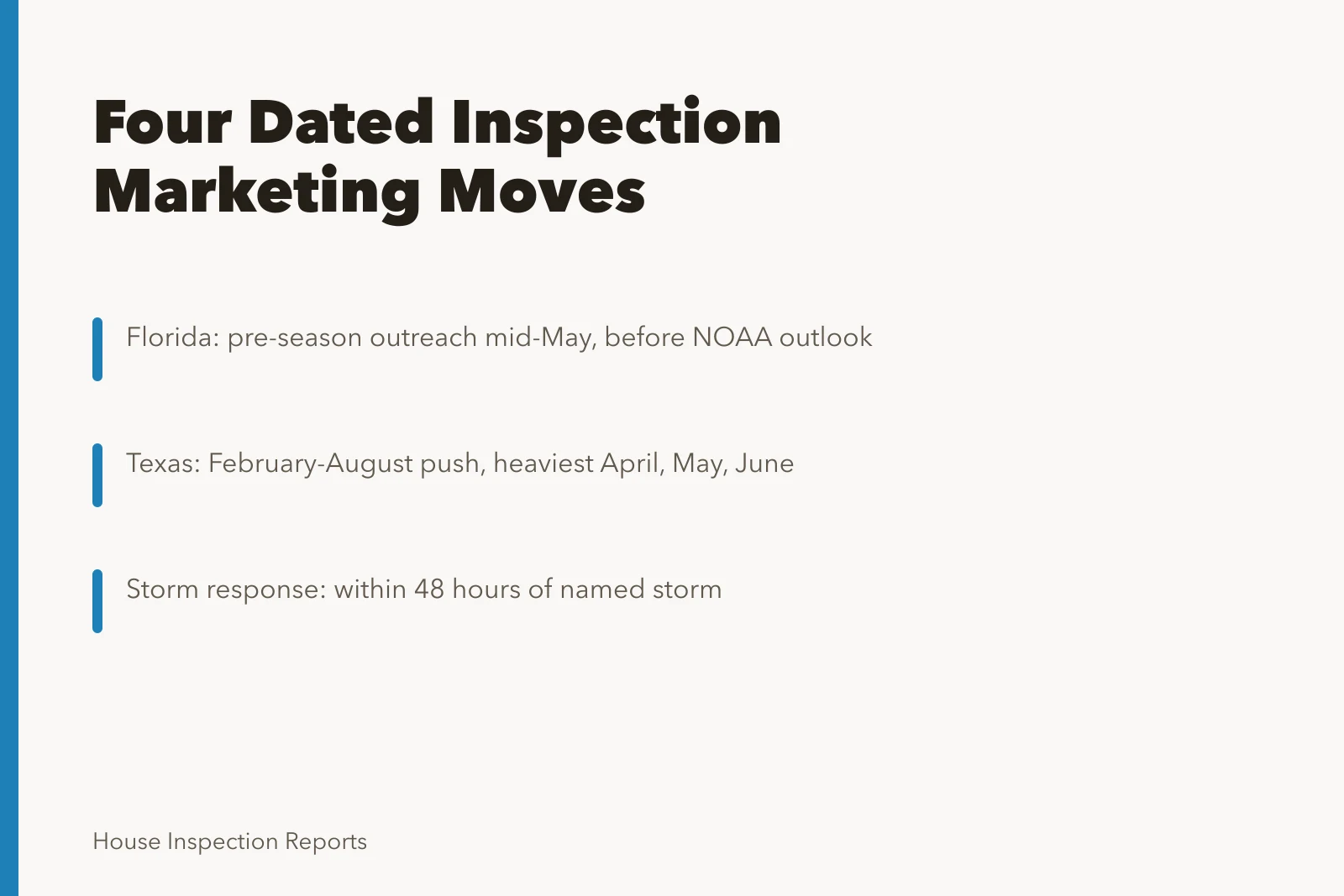
Timing: mid-May, before the NOAA Atlantic hurricane season outlook is released and before June 1.
Goal: be the inspector agents and past clients think of when the season starts.
This is the cheapest move on the calendar because nothing has happened yet. You are not competing with emergency repair crews or insurance adjusters for attention.
Start with past clients. Anyone whose inspection was more than a year ago is a candidate for a short pre-season email: what to check before a storm, how to document roof and window condition, and how to reach you for a re-inspection.
Then work your agent list. The message is not a discount. It is availability. Tell them how many inspections you can hold open per week in June and July, and how fast reports go out.
Pre-season outreach examples
- Past client email subject"Before the season starts: three checks for your roof and windows"
- Agent email"Holding four slots a week through June for wind mitigation and roof inspections"
- Text to a top referring agent"Season starts June 1. Want me to block two afternoon slots for your listings?"
- Social posta photo of a roof-to-wall connection with one line on why it matters in a wind event
The point is not volume. It is being named when the first storm forms. NOAA weather resources are the source agents check, so reference the season start and let the outlook carry the urgency.
Move two: closing-peak campaigns in Texas
Timing: February through August, heaviest in April, May and June.
Texas closings do not wait. Once a buyer goes under contract, the inspection window is often five to seven days. Your campaign has to reach agents before that window opens.
Build the campaign around capacity, not price. Agents refer inspectors who answer the phone, show up on time and deliver a report the same day. Say that plainly in every message.
Steps to run the Texas peak campaign
Texas peak campaign
- Pull your agent list and rank it by inspections booked in the last 12 months.
- Send a March email to the top tieryour April and May slots, plus your report turnaround time.
- Call the top 20 agents in the first week of April and ask what their May pipeline looks like.
- Post weekly availability updates in local agent Facebook and Slack groups through June.
- In July, thank the agents whose spring deals closed and ask each for one referral.
Worked example: one Houston agent, one quarter
An inspector in Houston emails 40 agents in March. Six reply. Two book inspections in April. One of those agents adds the inspector to a preferred vendor list in May. By August, that single relationship has produced nine inspections. The cost was one email and two follow-up calls.
That is the shape of Texas peak marketing: low cost, high repetition, tied to the closing calendar. For the follow-up side of those agent conversations, see how to win more home inspection clients.
Move three: storm response after a named event
Timing: within 48 hours of a named storm making landfall or a major flood, then again two to four weeks later.
Storm response is not general marketing. Demand spikes, then fades. You have a short window to be visible and a longer one to be useful.
First, confirm you can work. If your own office, vehicle or equipment was damaged, FEMA business assistance and SBA disaster loans are the first stops before you market anything.
SBA disaster assistance offers low-interest relief loans to small businesses hit by hurricanes or floods, which can fund equipment replacement so you can take jobs again.
Second, publish one availability notice: a page on your site, a social post, an email to agents. State your service area, turnaround time and how to book.
Third, expect two waves. The first is urgent: roof, water intrusion, structural checks. The second, two to four weeks out, is documentation for insurance claims and repairs. Both are inspection work.
Storm-response outreach examples
- Agent email"Back in service after the storm. Same-day reports on water intrusion and roof checks in [county]."
- Past client text"If you are filing a claim, I can document roof and ceiling conditions with photos and a written report."
- Website bannerservice area, phone number, expected turnaround
- Local Facebook group posta short checklist of what to photograph before repairs begin
Keep the tone factual. Storm-affected clients are not shopping for a deal. They are looking for someone who answers.
Move four: off-season retention
Timing: September through January in Texas, December through May in Florida.
Off-season is when referrals are built. The inspection is a transaction. The relationship after it is the asset.
Start with past clients. A twelve-month anniversary email with a home maintenance checklist keeps your name in the inbox without asking for anything. Add one line: if they know someone buying or selling, you would appreciate the introduction.
Then agents. In the slow months, offer something useful: a lunch-and-learn on roof or foundation issues, a short guide to what inspectors flag most often, or a joint checklist for their listings. This is where a home inspection quote template gets built, one agent at a time.
Retention checklist
- Send a 12-month anniversary email to every past client
- Call your top 10 referring agents in the slow month
- Offer one lunch-and-learn or office presentation per quarter
- Update your Google Business Profile with recent photos and service details
- Ask three past clients for a review and one referral each
- Review report turnaround time and fix the slowest step
Local search matters here too. Most off-season leads come from people searching for an inspector nearby, which is why local SEO does more for a slow month than another discount offer.
Dated calendar for home inspection marketing peak season
Use this as a starting template, then shift the dates to your own market and capacity.
Dated Marketing Calendar
- FebruaryTexas spring peak begins
- MayFlorida pre-season email before June 1
- JuneHurricane season starts
- SeptemberFlorida peak storm risk
- NovemberHurricane season ends
- JanuaryBudget and list cleanup
Dated calendar
| Month | Florida focus | Texas focus | Primary action |
|---|---|---|---|
| February | Off-season retention | Spring peak begins | Agent calls, availability email |
| March | Off-season retention | Spring peak | Lunch-and-learn, referral asks |
| April | Pre-season prep | Peak closing volume | Weekly availability posts |
| May | Pre-season outreach | Peak closing volume | Pre-season email before June 1 |
| June | Hurricane season starts | Summer closings | Storm readiness notice to agents |
| July | Season monitoring | Summer closings | Mid-season agent check-in |
| August | Season monitoring | Late summer closings | Referral thank-you notes |
| September | Peak storm risk | Off-season begins | Storm-response plan on standby |
| October | Peak storm risk | Off-season retention | Past client maintenance email |
| November | Season ends | Off-season retention | Annual review of booked jobs |
| December | Off-season retention | Off-season retention | Planning for next year |
| January | Off-season retention | Spring prep | Budget and list cleanup |
Two states, one row per month, one action per cell. A month with no action is a gap you found on paper instead of in your bookings.
NOAA climate data can refine the Florida side, especially across counties with different storm exposure. Texas refinements come from your own booking history, not from weather.
Measuring each move against booked inspections
Marketing that cannot be counted will not survive a slow quarter. Pick one number per move and track it for the full cycle.
Scorecard Numbers to Track
- 14 daysJobs booked after a storm event
- 12 monthsAgent bookings used to rank list
- 2 cyclesCut anything that produced nothing
- 2 times a yearReview the log in January and July
For pre-season outreach, count inspections booked in June and July from May contacts. For the Texas peak, count inspections per agent contacted. For storm response, count jobs booked in the first 14 days. For retention, count referrals from past clients and agents over the off-season.
Keep a log: date, move, audience, cost, inspections booked. Review it in January and again in July. Cut whatever produced nothing two cycles running.
The market is moving toward fewer transactions with more scrutiny per transaction, and the range of home inspection services rewards inspectors with repeat agent relationships over one-off ad spend. Your calendar should reflect that.
A simple scorecard
- Inspections booked per campaign
- Cost per booked inspection
- Agent contacts converted to a first booking
- Past client referrals per quarter
- Report turnaround time, in hours
Five numbers, reviewed twice a year, tell you which of the four moves deserves next year's budget.
Common questions
When does Florida hurricane season start and end?
June 1 through November 30. Land your pre-season outreach in May, before the NOAA outlook resets the conversation in coastal markets.
What is the Texas closing peak?
Spring buying runs February through May, with summer closings into July and August. Reach agents before each contract window opens, since inspection deadlines often fall five to seven days out.
Should I discount inspections after a storm?
No. Demand is urgent and capacity is limited. Compete on availability and turnaround time, not price.
How do I market if my own business was damaged?
Check FEMA business assistance and SBA disaster loans before you spend on marketing. Funding equipment replacement lets you take jobs again sooner.