Guides
What do Canadian inspectors need before expanding into the U.S.?
Canadian inspectors moving into the U.S. need a work visa, a U.S. entity, an EIN, U.S. liability coverage and a state license where one exists.
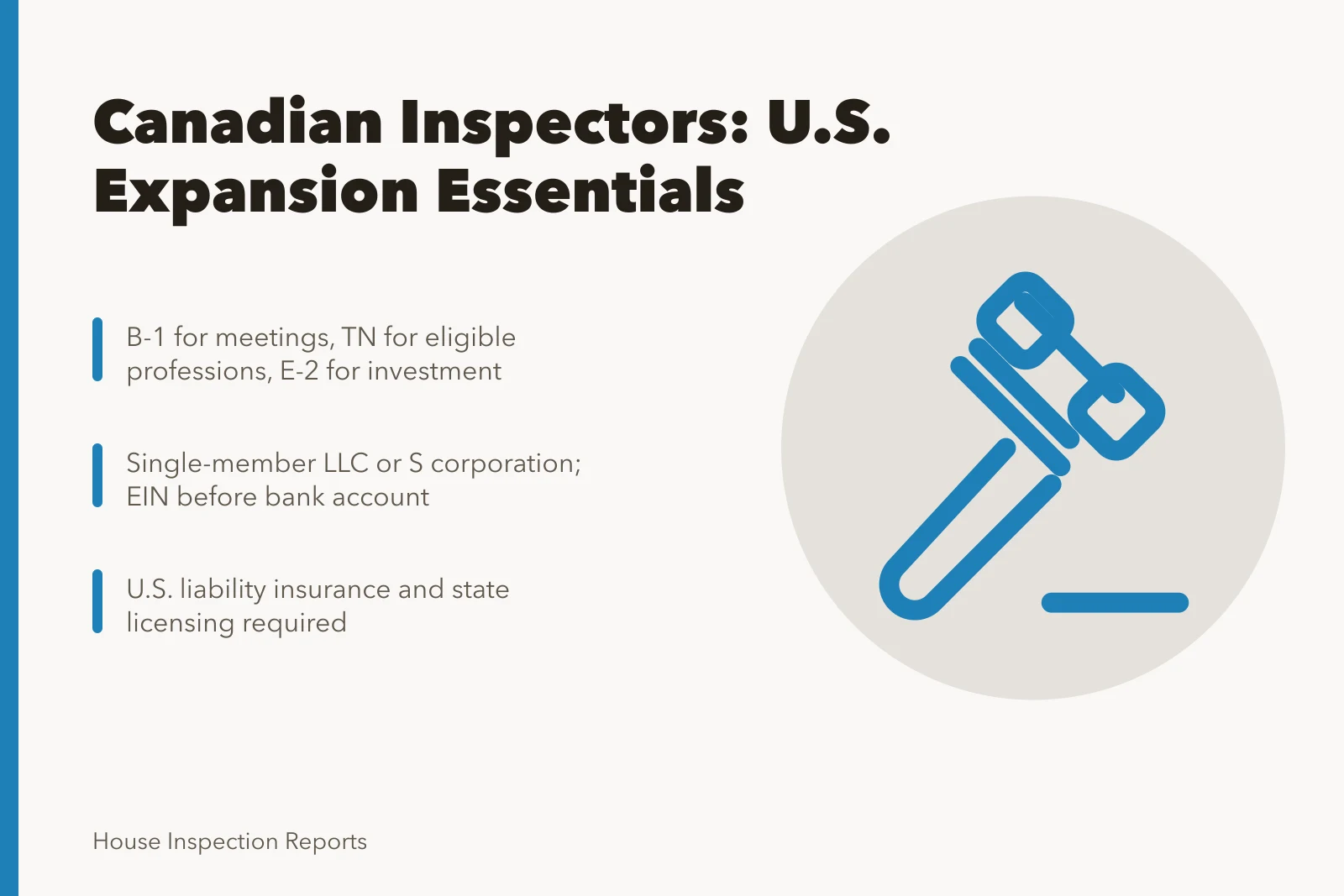
What to take away
- Paid inspection work is not a visit. B-1 covers meetings only; TN, E-2, L-1, H-1B or a green card are the routes that allow hands-on work.
- A single-member LLC is the usual first U.S. entity. It needs an EIN before any U.S. bank will open an account.
- Many Canadian errors and omissions policies exclude U.S. work. Ask your insurer three questions before you quote a U.S. client.
- No U.S. state accepts a Canadian inspection credential. Licensed states start you at zero; unlicensed states run on ASHI, InterNACHI or NAHI membership.
- SBA 7(a) lending and free SBA counseling are open to eligible foreign-owned U.S. businesses.
- One state, one metro, one inspector. A staged entry limits what a wrong decision costs.
Visa categories that allow paid inspection work
Canadians enter the U.S. for short trips without a visitor visa. Inspecting a house for pay is work, and work is a different question. The category you need depends on whether you invest, manage, or hold the flashlight.
B-1 business visitor. Meetings, trade shows, contract talks and site visits. It does not cover inspections delivered to U.S. clients. Use it to scout a market, meet brokerages and sign a lease, then leave.
TN under USMCA. The TN category comes from the trade agreement between Canada, the United States and Mexico and covers listed professions. Home inspector is not on that list.
A TN is realistic only if you hold a qualifying degree and take a role such as engineer, architect or management consultant. It ties you to one employer and needs a support letter at the border.
E-2 treaty investor. Fits an owner who puts substantial capital into a U.S. inspection company and directs it. The enterprise must be real and not marginal. E-2 renews in increments and does not lead directly to a green card.
L-1 intracompany transferee. Use L-1A for managers or L-1B for specialized knowledge when your Canadian company already operates and you will manage a U.S. affiliate. The two entities need a qualifying corporate relationship.
H-1B and permanent residence. An H-1B needs a U.S. employer, a degree-level role and the annual cap, which is a hard fit for a small inspection firm. A green card through investment, family or an employer is the long route.
Best for
- B-1
- Market scouting, meetings
- TN
- Listed professions only
- E-2
- Owners investing capital
- L-1
- Managers moving to a U.S. affiliate
- H-1B
- Degree-level roles, cap subject
Paid inspections
- B-1
- No
- TN
- Yes, for the petitioning employer
- E-2
- Yes, in the E-2 enterprise
- L-1
- Yes, for the affiliate
- H-1B
- Yes, for the sponsoring employer
The visa is half the move. The other half is a U.S. entity, a bank account and a tax identity, and those take longer than most inspectors expect. An immigration attorney should confirm your category before you sign anything.
Choosing a U.S. entity: sole proprietor, LLC or corporation
A Canadian sole proprietorship does not carry into the United States. You form a U.S. entity, or you operate as a foreign individual and inherit withholding and reporting problems.
Choosing a U.S. Entity
Sole proprietor
- Liability shield
- No
- Separate tax return
- No
- Bank account ease
- Hard
- Can issue shares
- No
- Best for
- Testing
Single-member LLC
- Liability shield
- Yes
- Separate tax return
- No
- Bank account ease
- Clean
- Can issue shares
- No
- Best for
- One or two
Corporation
- Liability shield
- Yes
- Separate tax return
- Yes
- Bank account ease
- Clean
- Can issue shares
- Yes
- Best for
- Raising money
Sole proprietor. A Canadian resident can operate as a U.S. sole proprietor and file Schedule C. It is cheap and fast. It also leaves personal assets exposed and makes a U.S. business bank account hard to open.
Single-member LLC. The common first choice. The IRS treats it as a disregarded entity by default, so you report the income on a personal return. You get liability separation and a clean bank account without a separate corporate return.
Multi-member LLC or partnership. Two inspectors going in together file a partnership return. You need a written operating agreement covering ownership, distributions and what happens if one partner leaves.
Corporation. A C corporation pays its own tax and can retain earnings. An S corporation avoids double taxation but carries owner restrictions that can trip up nonresident aliens. The IRS businesses hub sets out entity types and deductions.
The choice drives what you can do later. A disregarded LLC is simple but issues no investor shares. A corporation can raise money and grant equity, which matters if you want a partner or a buyout.
For one or two inspectors, the LLC usually wins on cost and filing burden. For a multi-state company with investors, the corporation is the better shell. A tax treaty between Canada and the United States sets how profits are taxed and can reduce withholding on payments crossing the border.
A business plan that names the entity, the formation state and the tax election keeps your accountant and attorney on the same page. Wyoming, Delaware and Florida are popular for cost and privacy, but you still register as a foreign entity in the state where you inspect.
Liability insurance that a U.S. client will accept
This is where cross-border expansions fail quietly. A Canadian errors and omissions policy written for Canadian work often excludes U.S. operations. A U.S. client, realtor or lender asks for a certificate before you inspect.
Insurance Readiness Check
- Policy covers work performed in the U.S.
- U.S. entities named as insureds
- Certificate issued to U.S. realtor
- At least $1 million aggregate coverage
- Cross-border endorsement ordered
- Exclusions on prior and subcontractor work read
Recognition means a U.S. carrier, or a Canadian carrier with U.S. admitted paper, agrees to cover your U.S. inspections. Without it you are personally exposed on every report you deliver.
Ask your current insurer three questions. Does the policy cover work performed in the U.S.? Does it name U.S. entities as insureds? Will it issue a certificate to a U.S. realtor? A no on any point means you need a U.S. policy.
Expect the U.S. policy to stand apart from your Canadian one. General liability, errors and omissions, and in some states a license bond are separate items. Premiums vary by state, claims history and whether you add mold or radon testing.
Coverage limits matter to clients. Many U.S. brokerages want at least a $1 million aggregate, and some franchise networks want more. A certificate naming the wrong insured, your Canadian company instead of the U.S. LLC, gets rejected.
Keep the two programs coordinated. On a claim that spans both countries you do not want each insurer pointing at the other. A broker who writes both sides can add a cross-border endorsement and set the order of coverage.
Read the exclusions on prior work and subcontractor work, because those clauses bite hardest during a fast expansion. The guide to insuring a home inspection business covers policy types, premiums and the gaps that surface at claim time.
Licensing: no Canadian credential transfers
There is no U.S. home inspection license that transfers from Canada. Regulation is by state, and states differ sharply.
Licensing by State Type
Licensed states
- Examples
- Texas, Illinois, New York
- Requirement
- Courses, exam, CE
- Canadian credential
- Does not satisfy
- Market signal
- State license
Unlicensed states
- Examples
- Arizona, Georgia
- Requirement
- None
- Canadian credential
- Not needed
- Market signal
- ASHI, InterNACHI, NAHI
Licensed states. Texas, Illinois, New York and Washington are among those that license home inspectors. Texas licenses through the Texas Real Estate Commission, with required courses, an exam and continuing education. A Canadian credential does not satisfy those hours.
Unlicensed states. Many states, including Arizona and Georgia, do not license home inspectors. There the market signal is association membership. ASHI, InterNACHI and NAHI each offer credentials and continuing education that U.S. realtors recognize.
Reciprocity. Some states recognize other U.S. state licenses. Canadian provincial credentials generally sit outside those agreements. Assume you start from zero in a licensed state.
Standards and reporting. U.S. reports follow a state or association standard of practice, and consumers expect the ASHI or InterNACHI format. Reports for federally related transactions can carry extra requirements through HUD. Building codes differ between the two countries, so a report written for an Ontario client may not cover what a Texas buyer expects.
Continuing education. Most licensed states require it annually or biennially. Check whether your Canadian courses count, because many do not.
Confirm the state board's requirements in writing before you print a single report. A home inspection startup view helps here: in a licensed state, treat licensing as a fixed cost and a fixed timeline, not a formality.
EIN, banking and federal filing
Every U.S. entity needs an employer identification number, and so does a sole proprietor with a U.S. bank account or employees. The EIN is the business tax identity.
EIN and Federal Filing Path
- Apply for EIN on Form SS-4
- Open U.S. business bank account
- Disregarded LLC: owner reports income
- Partnership: Form 1065 and K-1s
- Corporation: Form 1120 or 1120-S
- State franchise taxes and annual reports
Applying is free by phone, fax or mail on Form SS-4 when the applicant has no Social Security number. Many Canadians complete it before opening a bank account. The IRS instructions for how to get an employer identification number cover who needs one and how to apply.
Banks ask for the EIN, formation documents, the operating agreement and photo identification. Some also want a U.S. address, which is one reason to lease a small office or use a registered agent address.
Filing follows the entity. A disregarded LLC files no separate federal return but the owner reports the activity. A partnership files Form 1065 and issues Schedule K-1s. A corporation files Form 1120 or 1120-S. State franchise taxes and annual reports are separate, and some states charge a minimum tax with no income.
Payroll adds a layer. Hiring a U.S. inspector means a payroll provider, workers compensation coverage and state registrations.
Hiring a Canadian inspector to work in the U.S. makes the immigration and tax questions harder, so get advice before the first paycheck.
Sales tax generally does not apply to inspection services, but some states tax ancillary services or tangible items. A CPA should set the filing calendar before your first U.S. return.
SBA funding and free counseling
SBA programs are open to eligible businesses owned by non-citizens, including Canadians, when the U.S. business is properly formed and the owner is legally present to operate it.
The flagship is the SBA 7(a) loan, a partially backed loan made by a participating lender. Terms vary by lender. Proceeds can fund equipment, working capital, leasehold improvements and, in some cases, the purchase of an existing U.S. inspection company.
Lenders want a U.S. tax return or a credible projection, a personal guarantee and often collateral. A new U.S. entity with no history is a hard sell, so a Canadian track record, a U.S. expansion plan and a realistic startup costs explained budget help.
Micro-loans and community development financial institutions serve smaller amounts, and state or local economic development offices sometimes add grants or training funds for new employers.
Counseling is free and worth using early. The SBA offers free small business counseling and local mentoring through its network, including help with business plans, loan packaging and market research.
A counselor can also point you to the right state licensing and tax registrations. For a plain-language overview of forming and funding a U.S. business, the USAGov start and fund guide walks through registration, permits and financing in one place.
A staged entry plan
Order matters. Skip a step and you often pay for it twice.
Staged U.S. Entry Plan
- Pick one state and metro
- Choose visa route with attorney
- Form entity, get EIN, open bank
- Bind U.S. liability coverage
- Deliver reports under local standard
- Add second inspector only when profitable
Run this checklist before you commit capital:
- State licensing requirements confirmed in writing
- Visa category chosen with counsel
- U.S. entity formed and registered in the operating state
- EIN issued and U.S. bank account open
- U.S. liability policy bound with the right named insured
- Federal and state filing calendar set with a CPA
- SBA counselor or mentor engaged
- First-year budget built from real quotes
Keep the Canadian and U.S. books separate from day one. Commingled funds confuse lenders, insurers and the IRS.
When the U.S. operation is stable, a second state repeats the same process rather than inventing a new one.
If you are still weighing whether to move at all, the guide for businesses ready to expand covers the market signals worth watching first.
Common questions
Do I need a visa to inspect homes in the U.S. as a Canadian?
Yes. Paid inspection work is not covered by visitor status, and B-1 covers meetings only. TN, E-2, L-1, H-1B or a green card are the realistic routes for hands-on work.
Can I keep my Canadian company and add a U.S. LLC?
Yes, and it is common. The U.S. LLC holds the U.S. contracts, bank account and insurance while the Canadian company stays as it is. Get tax advice on how the two relate.
Will my Canadian liability policy cover U.S. inspections?
Often not. Many Canadian policies exclude U.S. work or will not name a U.S. entity as insured. Ask your insurer directly and be ready to buy a U.S. policy.
Can a Canadian-owned U.S. inspection company get an SBA loan?
Yes, when the U.S. business is properly formed and the owner is legally present to operate it. Lenders still apply their own credit and collateral rules.