Guides
3 things to understand about home inspection startup
Opening a home inspection startup comes down to three decisions about what you will inspect, what a job costs you, and who signs the report.
What to take away
- Your license is the product. In most states a licensed inspector must perform the inspection and sign the report, so the first hire is not optional.
- Price from cost per inspection, not from what the office down the road charges. A fee that does not cover drive time, report writing and E&O premium is a slow loss.
- Ancillary services (radon, mold, sewer scope, wind mitigation) carry their own certification, their own insurance question and their own report form.
- Confirm licensing, radon rules and tax registration with your state board, the EPA and the IRS before you print a business card.
- Run the numbers in your own metro. Phoenix and Houston do not price the same job the same way.
This article covers business operations only. It is not engineering, building-code, real-estate, legal or tax advice.
Scope and duties depend on your jurisdiction and your standard of practice. They also depend on the property and your agreement. Confirm current requirements with these sources:
- your state licensing board
- a licensed attorney
- a CPA
- the applicable code authority
- a licensed professional engineer
For radon or mold questions, confirm with the EPA or a certified industrial hygienist.
What the title actually asks
Three things decide whether an inspection company opens and stays open. What you will inspect. What one job costs you. Who is allowed to sign the report.
Everything else, the logo, the truck wrap, the website, is downstream of those. Owners who start with the website usually redo it within a year.
Decide your scope and your license before you sell
A home inspection is a visual, non-invasive survey of the readily accessible systems and components of a house. InterNACHI and ASHI each publish a standard of practice that lists what is included and what is excluded. Read the standard your state or your association adopts before you write your own scope.
Ancillary Services and Credentials
- Radon testingseparate license or certification
- Mold assessmentcertification and liability
- Sewer scopecamera equipment and training
- Wind mitigationinsurer or state form
- WDO lettersstate pesticide license
Your state board sets the license. Most states require a licensed inspector to perform the inspection and sign the report, and many require continuing education to renew. Some states license only the individual, not the company, which means the company cannot inspect without that person on staff.
Florida requires 120 hours of approved pre-license training before the exam. Illinois requires 60 hours. Arizona has no statewide license.
Ancillary services sit outside the base inspection and each carries its own credential:
- Radon testing. The EPA's Home Buyer's and Seller's Guide to Radon explains test conditions, documentation and timing. Many states require a separate radon license or certification.
- Mold and moisture assessment. Sampling and lab work, with its own certification and its own liability.
- Sewer scope. Camera work that needs equipment and training, and that finds things a visual inspection cannot.
- Wind mitigation and four-point forms. Florida and Texas carriers use these to set premiums. The form is set by the insurer or the state, not by you.
- WDO or termite letters. Usually a separate state pesticide license.
Each one adds a report form, a certification renewal and an insurance question. Add them one at a time, after the base inspection runs clean.
Cost per inspection: the number that sets your fee
The fee is the easy number. The cost is the one that decides whether you have a business.
Per-Inspection Cost Variables
- Inspector labourhourly rate x hours
- Drive time and mileage between jobs
- Software and report platform fees
- E&O and general liability premium
- Continuing education and license renewal
- Phone, scheduling, payment processing
- Cancelled jobs after driving out
- Inspector labourhourly rate times hours on site, plus report writing time. The BLS Occupational Employment and Wage Statistics tables publish wage estimates by metro, which is a starting point for your local market, not a substitute for it.
- Drive time and vehiclehours behind the wheel plus fuel and maintenance.
- Insurance and fixed costsE&O premium, general liability, software and phone, divided by inspections per year.
Add those, and you have a floor. Price below it and volume makes the loss bigger, not smaller.
A worked example with typical numbers. A solo inspector charges $450 a job. On-site time is 3 hours at $35 an hour, or $105. Report writing adds 1.5 hours, or $52.50. Drive time averages 1 hour, or $35.
A $3,000 annual E&O premium over 200 inspections is $15 a job. Software and phone add $5. Variable cost per inspection lands near $212. That leaves about $238 before fixed overhead and taxes.
A Phoenix inspector running six jobs a day in summer heat and a Houston inspector running four with an hour of drive time between them do not have the same cost per job. Same license, same standard of practice, different arithmetic.
Who signs the report and who carries the liability
The report is the deliverable, and the signature on it is the liability. E&O insurance covers the inspection you performed, within the scope you agreed to. It does not cover the inspection you did not perform.
Report Signing and Review Flow
- Licensed inspector performs inspection
- Inspector writes report
- Report reviewer checks before delivery
- Reviewer catches missed photo or ambiguous finding
- Signed report delivered to client
That shapes hiring. A new company with one licensed inspector is a company that stops earning when that person is sick. A report reviewer who checks reports before delivery catches the missed photo, the ambiguous finding and the scope language that will not hold up.
Write the role before you write the ad. For each hire, name what they decide, what they record, what they hand off, and who they escalate to. A scheduler who cannot move a job without the owner is not a scheduler.
The paperwork that has to exist first
Three registrations come before the first paid inspection.
Three Registrations Before First Paid Inspection
- IRSchoose structure, get EIN, understand taxes
- SBAmarket research, costs, permits, insurance
- State licensing boardlicense, scope, renewal, complaints
The IRS starting a business page covers choosing a structure, getting an EIN where required, understanding business taxes and keeping records from day one.
The SBA business guide lays out the general sequence.
- market research
- startup costs
- permits
- insurance
- finance
- hiring
- expansion
Use it to separate the general startup work from the parts that need an inspection-specific answer.
Your state licensing board comes third, and it comes first in importance. It sets the license, the scope, the renewal and the complaint process. Read its current rules before you commit to a service menu.
Typical startup costs and first-year revenue
A solo inspector usually spends $5,000 to $12,000 to open. Training and licensing runs $1,500 to $4,000. E&O plus general liability runs $2,500 to $4,500 in the first year.
Tools and a basic sewer camera run $1,000 to $3,000. An LLC filing fee runs $50 to $500 by state. Software, a website and a logo run $1,000 to $3,000.
Typical fees run $350 to $500 for a single-family house. First-year revenue tracks volume and fee. A solo inspector who completes 250 inspections at $425 bills about $106,000 gross. Below 200 inspections or below a $350 fee, margins thin fast.
Where new owners lose money
Four failure cases show up again and again.
Four Common Failure Cases
Failure
- Late jobs
- Overbooking
- Missed defects
- Overbooking
- Scope disputes
- Unclear exclusions
- Coverage gaps
- Carrier not told
- Expansion across states
- License not portable
Cause
- Late jobs
- Realistic capacity
- Missed defects
- Realistic capacity
- Scope disputes
- Written scope talk
- Coverage gaps
- Notify carrier
- Expansion across states
- Check state rules
Fix
- Late jobs
- Missed defects
- Scope disputes
- Coverage gaps
- Expansion across states
Late jobs and missed defects. Both trace back to booking more inspections in a day than the inspector can actually complete well. Capacity is not the theoretical maximum. It is available hours minus drive time, setup, report writing, breaks and rework.
Scope disputes. The client expected the roof. Your agreement excluded the roof. The fix is a scope conversation before the inspection, in writing, with the exclusions named.
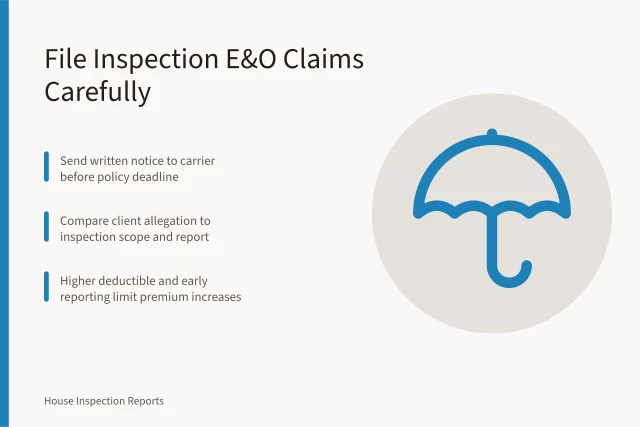
Coverage gaps. You added radon testing and did not tell your carrier. The claim arrives and the policy does not respond.
Expansion across state lines. A license in one state does not travel. Neither does a radon certification, and neither does a relationship with a real estate brokerage.
A first 90 days that holds up
- Days 1 to 30confirm the license path with your state board, register the entity and EIN with a CPA, and price one service from real cost variables. Target: a written price floor at least 2.5 times variable cost per inspection.
- Days 31 to 60run ten inspections at a deliberately low volume. Time each one end to end, including report writing, and record where the day broke. Target: a measured cost per inspection within $25 of your estimate.
- Days 61 to 90add one ancillary service with its certification and its insurance check, then review cost per inspection against the fee you charged. Target: cost per inspection at or below 55 percent of the fee.
The home inspection business plan is where those three months get written down, so the second year starts from a number instead of a memory.
Common questions
Do I need a license to start a home inspection company?
In most states, yes, and the license belongs to the individual inspector rather than the company. Check your state board for the current requirement, the experience hours and the continuing education. A few states have no statewide license but still expect adherence to a recognized standard of practice.
How do I price my first inspections?
Start from cost per inspection, then compare to your metro. Phoenix, Houston and a rural county do not carry the same drive time or the same fee. Price at or above your floor, and raise it when your calendar fills more than two weeks out.
Can I offer radon or mold testing right away?
Only with the certification your state requires and the insurance your carrier will write. The EPA's radon guidance is the place to start on test conditions and documentation, and your state radon program sets the licensing. Add these services after the base inspection is running clean.
What insurance does an inspection company need?
At minimum, errors and omissions plus general liability, and both should name every service you actually perform. Tell your carrier before you add radon, mold or sewer scope.